Mexican American History II Southwestern College, Spring 2009 Dr Rich Gibson, Emeritus Professor San Diego State University Personal Web Page: http://www.richgibson.com/ Email: Rgibson@pipeline.com Einstein: “It is the theory which sets up what is observed.” Hegel: “The purpose of education is transformation, toward an ethical person.” Dickens: (in Hard Times, Gradgrind speaking): “Facts! I want nothing, nothing, but facts!” Freire: “To act as if truth belongs only to a teacher is not only preposterous, but false.” Goodman: “Whether or not it draws on new scientific research, technology is a branch of moral philosophy, not a science.” Marx: “Philosophers have only interpreted the world, in various ways. The point is to change it.” Opening Remarks Our class covers the history of the Mexican-American and American-Mexican experience from 1846 to the present day. We will emphasize the political, economic, and social experiences of the Mexican American people under the influences of Mexico and the United States. We will address the interrelated histories of both countries and their relationship with the world. The class includes a study of the Constitution of California. The history of the border is so porous that it is a stretch to say the people of each nation influenced each other in profound ways, as the people of each nation are often the same people, the borders moving back and forth across them–but the people moved as well. Why? We will study these movements as a relationship, an interaction, a unity of many contradictions that involve domination and resistance, democracy and tyranny, freedom and oppression, reaching to our current situation. This is your guide to our class. Ours is a very fast-paced course dealing with vital questions which set up our current situation. I ask you to work with your colleagues to create a climate where ideas, evidence, and argument matter, where everyone is valued for the part of the truth that they can contribute, and where we learn to agree and to disagree reasonably and productively–yet passionately. While I will do all I can to be available to help every student; you are responsible for your own education. This process will work best if we cooperate to create a community that includes the following: 1. Our ideas matter. They set up our deeds. There are worthy things to be learned. We need to be able to be critical, reflective, caring, hard-working; yet detached enough that we can see that there are many ways of knowing something, and each of us may bring a different way. Passion is a big part of learning, as is understanding that all knowledge is partial, and we might just be, even partially, wrong. Mutual respect and humility make sense. Contempt doesn’t. This does not mean, however, that there is no way to test for the value of given ideas, no way to determine where correct ideas come from. Some ideas, after all, are better than others. 2. Our collective may offer greater wisdom than any one of us. This only happens if we struggle seriously for what is true. We may never agree, but our disagreements will be clearer if grounded in evidence. Soldiering, doing the minimum, poisons the common well. Being a student, or a professor, means extending curiosity, not limiting it. Civility in discussion is expected. Basics Class will begin and end on time. Arrive promptly with assignments completed. Please shut off cell phone ringers. Our task is to answer, “Why are things as they are?” with the understanding that people make their own histories, but do not choose their birthrights. We will ask fundamental, to the root questions, from “What is History,” to “Why are we here?” to, “why do things change, if they do?” and many in between. I will share my outlook with you–not expecting that you accept it–and criticize your standpoints as well, with respect for ideas rooted in evidence. You will be asked to become a historian, or be aware that you are a historian now. In developing a critical outlook, asking to-the-root questions, in being better able to locate your own historical situation, you will be able to make better decisions about your future. That is one reason why history matters. At the end of the class, you should be able to better answer the question, “Who am I, in relation to others?” I can and do lecture. However, much of learning history, or anything, comes through dialogue. I will pose questions; history as a problem. Part of your responsibility in the class is to speak up and struggle for truthful answers. You will often work in groups. Find a friend–priceless. Every student is concerned about grades, for good reasons. However, solely performing for a grade can lead to a “tell me what to do and I will do it,” outlook that I do not want to foster. It’s the psychology of slaves: obedience and loyalty. More about grades below. You will be asked to do critical research. The purpose of research is to try to better understand and change the world. Today, this is a life and death matter. It may be that you have already developed a research question to propel your intellectual work–or perhaps not. The question that continues to interest me, in general, is this: What is it that makes it so easy to turn people into instruments of their own oppression (Confederate troops on Picket’s Charge), or, inversely, what is it that people need to know, and how do we need to come to know it, in order to lead reasonably free, creative, connected lives, as distinct from engaging in mass perpetual industrialized slaughter? Further still, what is the relationship of how people learn to do what they do, and what they know—their conscious decision-making? As a historian with a future of intellectual and practical work, you should begin to think about a broad question that might puzzle you for years to come, or you may just find a fast breakthrough answer that leads to a new question. If you develop a good question now, it can guide you throughout college. While learning core dates is important, equally or more important is learning the processes of history; how and why things change. Through lectures, readings, writing, and discussion, we will examine the connections between historical events, the larger themes of the class, and their role in shaping today’s world. It is my goal that you will cultivate in this class the intellectual skills you will need to use your historical knowledge and interpretations in dealing with present concerns. After all, we cannot understand and act on contemporary problems unless we have some idea of how we got here in the first place. I encourage you to begin to view today’s world not just as “the way it is,” but as the way people in history have made it, and how you and I continue to make and remake it every day. This course should promote your development of a “critical historical imagination.” Attendance is vital. More than three un-excused absences (few absences are excused) will likely result in failure. If you’re not here to discuss – to share with us your thoughts – you won’t be getting all that you could out of the class. More importantly, your absence (physically or mentally) deprives the other students in the class who rely on you to help foster an atmosphere of open exchange. We each need everyone else’s participation to make this a useful class, so no sleeping, extraneous talking, texting, or reading during lecture and discussion. These activities will be considered absences. Our class will move very fast. The readings and writing requirements do not ease up, but get more demanding. Don’t fall behind. It will be very hard to catch up. Indeed, read ahead. Grades Testing, whether through essay exams, papers, or multiple choice tests is relatively subjective. I oppose high-stakes trick exams that set professors against students, causing many people to forget what they learned when the test is done. I prefer you write reading responses and essays in depth about research topics of interest to you. So, at the outset of the class, submit (by email) one short essay each week, around 100 words responding to some selection in the readings: What is said and what do you think about that? Emphasis is on what you think--and evidence for that. Bring a hard copy of what you wrote to each class. I may ask you to waive them, gleefully of course. In addition, I require that you write two 7-10 page essays (double spaced, usual margins) demonstrating research that you have done on a specific part of the readings. I expect you to cite at least three reputable sources (Wikipedia is “iffy” but often useful as a starting point). Use APA style. There is an example here (you’re not expected to read the paper, just look at how the citations are done): http://www.richgibson.com/curtain.htm Topics? You could do a research paper on the Industrial Workers of the World, The current Drug Wars, Zapata, Villa, Carey McWilliams, Change in Immigrations Laws, the bracero programs, etc. Some people find a question that needs to be answered, then look for a topic to answer it. Others take a topic that interests them, then find more questions that need to be answered. It is your choice. You may work in groups, but groups of no more than three. Be sure to ask me to approve your topic. I expect you to do research expanding beyond the assigned texts. If you have questions, email me. One paper is due mid-semester, one on the second to last class. In addition, at the second to last class, you will compile your short responses and longer papers as a modest portfolio. You may email the papers to me (in RTF) or give me hard copies in a stamped self-addressed envelope. If it appears to me that students are not doing the readings and responses, I foresee giving exams–multiple choice, essay questions, etc. None of us will enjoy that. Do the readings. Cheating or plagiarism will not be tolerated. Plagiarism is dishonest, unfairly sets the plagiarist against other students, and it cuts off the struggle for knowledge. Plagiarism is representing the work of another as yours .Don’t do it. Plagiarism will result in failure. Your evaluation of yourself should be more important to you than the grades I proffer. Even so, grading requires me to make some judgment about your work. That is not to say that grades are arbitrary; rather, they are based on your ability to demonstrate to me a level of understanding and critical engagement with the material. I have very rarely had complaints about grades. Students have typically found my judgments fair. You will not compete against each other and there will be no curving of grades. If everyone does mediocre work, everyone receives Cs. If all do excellent work, all get As. If you are concerned about how you are doing, let me know, and I will let you know if I believe your performance is sub-par. If you are reading this for the first time, early in the class, you have an A. Work to keep it. Aim high. Required Texts The primary texts are North From Mexico by McWilliams, and Mexican Americans, American
Mexicans, main editor is Matt Meier. The supplemental text Is Guest Workers or Colonized Labor by Gil Gonzalez. I believe these are among the best books in print on our topic. North From Mexico by McWilliams is a classic. McWilliams was one of the foremost journalists and historians writing about
the Southwest. His early work is, I think, unsurpassed. You may want to read, at some point, his book, Factories in the Fields, which is a non-fiction, and superior, rendition of Steinbeck’s Grapes of
Wrath. Matt Meier is more contemporary. His Mexican Americans, American Mexicans, is one of
the most widely used books for courses like this–and it’s a fine presentation. Fair disclosure: Gil
Gonzalez is a friend and colleague of mine. His book, Guest Workers or Colonized Labor, is, in my
humble opinion, a sharper and most surely more up to date take on our course of work. The Class Agenda
In each class, we will begin with an approximately 20 minute discussion of “What’s Up?” Part of being a historian is paying attention, critically. Over the years, you will remember the history that you lived. All history is an analysis of the past, from a standpoint in the present, that is embedded with a call to action in the future. Given the many present crises, we need to know what is up. Please bring a clipping from the NY Times or LA Times, or The Wall Street Journal (all are online)to each class and be prepared to discuss the issue your piece raises. (Gossip may make the world go ‘round, but let’s skip Anna Nicole, etc). We will develop a process of choosing what to discuss that will grow more sophisticated as the class progresses. Once we complete What’s Up? we will go on to discussions about the assigned readings. That discussion will begin with you working in small groups (no more than 4) reviewing your reading responses, deciding what you would like to discuss with the entire class, and why. Please come to class prepared to ask questions of your colleagues and me.
Check the syllabus and Blackboard each week for announcements and links to extensions from our discussions.
Calendar
Meeting 1: Introductions. Questions: Why are we here? What is history? What are the motive forces of history? What is our current context? Why take this class? What were you taught about history? How was it taught? Why? What do you remember most clearly? Why? Why have school? Who are you? Who is this professor anyway? How our class will work?
Meeting 2: What is up? Discussion of syllabus (make a copy and bring it to class). Chalmers Johnson (San Diegan author of the great Nemesis trilogy) says that Americans are so unaware of history they cannot connect cause and effect. Is that true? Why, or why not? Proof? What is our social context today? Download and bring to class Questions for Criticism at: http://www.richgibson.com/QUESTCRI.html (Save this). Read the synopsis of Carr’s, “What is History?” at http://www.geocities.com/elethinker/RG/compromisehistory.htm and Gibson’s Lie Spotters Manual at: http://www.richgibson.com/liespotter.htm Read the CIA World Factbook on the USA at https://www.cia.gov/library/publications/the-world-factbook/geos/us.html and the CIA World Factbook on Mexico: https://www.cia.gov/library/publications/the-world-factbook/geos/mx.html and the LA Times “Drug Cartels New Weaponry Means War” here: http://www.latimes.com/news/nationworld/world/la-fg-mexico-arms-race15-2009mar15,0,229992.story
Meeting 3. What is up? Read these links demonstrating my own method of analyzing how things change. http://www.richgibson.com/diamatoutline.html and http://www.richgibson.com/scedialectical4.htm What is your analytical method? Read “What is Racism (two pages, click link at bottom) here: http://www.richgibson.com/approach.htm Review “Race, the Power of an Illusion,” from PBS at http://www.pbs.org/race/001_WhatIsRace/001_00-home.htm Film, Salt of the Earth.
Meeting 4. What is up? Assigned reading–Chapter 4, “Manifest Destiny.” And Chapter 5, “Roots of the Poison,” in Mexican Americans (if you don’t remember the earlier history it would be a good idea to at least skim earlier chapters). Question: What is Imperialism? By the end of this day, your topic for your first paper should be submitted.
Meeting 5. What is up? Please read Chapters 7, 8 and 9 in Mexican Americans.
Meeting 6. What is up? Read Chapters 10, 11, and 12 in Mexican Americans.
Meeting 7. What is up? Read Chapters 13, 14 and 15 in Mexican Americans.
Meeting 8. What is up? Please read Chapters 16, 17 and 18 in Mexican Americans.
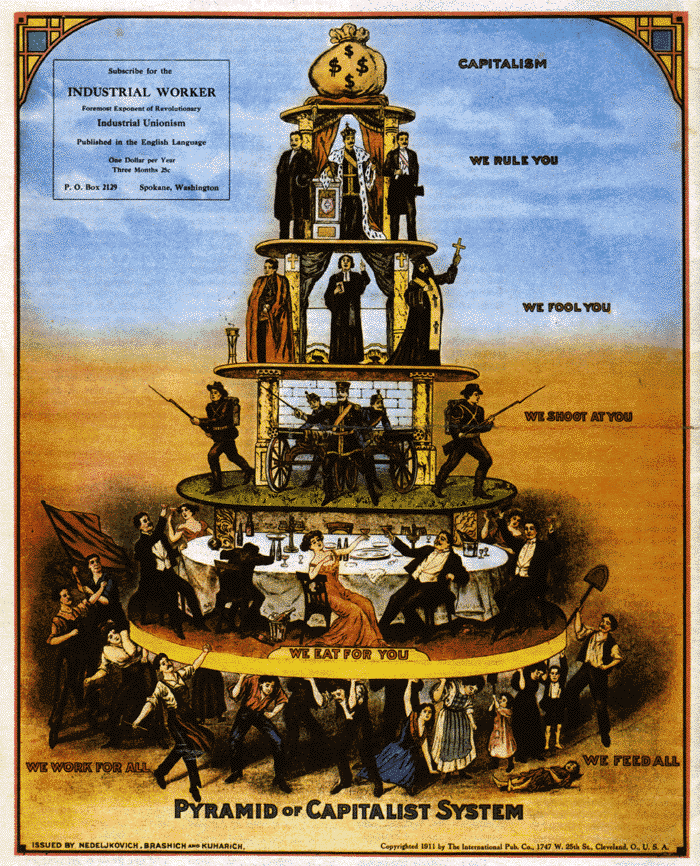
Meeting 9. What is up? At this point, we will ask a collective question: How is this class going and is it helping you understand and perhaps change the world? Read Chapters 10, 11 and 12 in Mcwilliams” North from Mexico. Read the Preamble to the Industrial Workers of the World constitution here: http://www.iww.org/culture/official/preamble.shtml and the IWW pyramid of the capitalist system here: http://www.iww.org/graphics/documents/posters/class_pyramid.gif
Meeting 10. What is UP? Please read Chapters 13 and 14 in McWilliams. RESEARCH PAPER NUMBER ONE IS DUE Meeting 11. What is up? Please read Chapters 15 and 16 in McWilliams. Meeting 12. What is up? Please read chapters 17 and 18 in McWilliams. Note the LA Times criticism of Chavez and the Farmworkers Union at http://www.latimes.com/news/local/la-me-ufw8jan08,1,7202033.story
Meeting 13. What is up? Please read chapter 19 in Mcwilliams and the introduction to Guest Workers or Colonized Labor by Gonzalez.
Meeting 14. What is up? Read the introduction and chapter 1 in Gonzalez. Let us review: What is imperialism? Remember, the Latin word, imperium, means “to rule.” Chalmers Johnson in his Nemesis Trilogy largely describes imperialism as hubris plus militarism (look up hubris). Lenin, in his book written about 100 years ago, Imperialism, the Highest Stage of Capitalism, summarized imperialism differently: 1) The concentration of production and capital developed to such a high stage that it created monopolies which play a decisive role in economic life. 2) The merging of bank capital with industrial capital, and the creation, on the basis of this “finance capital,” of a “financial oligarchy.” 3) The export of capital, which has become extremely important, as distinguished from the export of commodities. 4) The formation of international capitalist monopolies which share the world among themselves. 5) The territorial division of the whole world among the greatest capitalist powers is completed. Lenin summed up imperialism as monopoly capitalism and warned repeatedly that imperialism necessarily means war. Johnson most recently warned of war and bankruptcy. What do you think? What is you analytical take on our times and the US/Mexico relationship?
By the end of this day the topic for your second research paper should be submitted and approved.
Meeting 15. What is up? Read Chapter 2 in Gonzalez, please.
Meeting 16. What is up? Read Chapter 3 in Gonzalez.
Meeting 17. Read Chapter 4 in Gonzalez, please.
Meeting 18. Read Chapter 5 in Gonzalez and note: RESEARCH PAPER 2 DUE.
Meeting 19. Read chapter 6 and the Conclusion in Gonzalez. Portfolio Due–a collection of your short responses and your papers. Sent in rtf or hard copies in stamped self addressed envelope. Discussion on the California Constitution: http://www.leginfo.ca.gov/const-toc.html Meeting 20. Finals if necessary. Papers and Presentations.
This syllabus may be changed as the class progresses (extensions are inevitable).
|