Rouge Forum Dispatch: Mephistopheles on the March!
September 16th, 2018 / Author: rgibsonWe Say Fight Back!

Job Action Guidelines

by Rich Gibson
The strike is any worker’s most potent weapon. Short of guerilla warfare or revolution, the general strike is the highest form of open resistance. School workers strikes are especially effective because they immediately ruin the baby-sitting role schools play. Hence, a strike denies surrounding companies the full attention of their work force. Over time, strikes begin to expose the nature of school itself, an institution designed forthe most part not to serve the mass of people but only a tiny minority of the citizens. Even so, school can be a weapon for equality and democracy.
In the best of world’s, thorough strike preparations are frequently enough to be the justification for bargaining victories. Ours, more and more, is a defective universe. Preparations may well be not enough. Our preparations should be real, not sham. The employer should never be given reason to believe that they face a bluff.
A strike is a battle of will. But we should minimize the sacrifice the rank and file must make. A thoroughly prepared strike can draw a local and its community much closer together. But a poorly prepared strike, even if it wins on paper, can cause divisions that take a long time to heal.
The key components of strike readiness are:
A. Membership and Public Preparation
B. Legal Preparation
C. Financial and Materials Preparation
D. Communications, Planning–Strategy and Tactics
Lets take these one at a time. (Obviously, written years ago and updated in the late nineties. Still holds up as ok) richgibson.com/JOBACTIO.html
District files injunction, parents picket against teachers in Battle Ground ‘holding their kids hostage’ (set up Strike Freedom Schools to offset babysitting role)

BATTLE GROUND, WA (KPTV) – Teachers in Battle Ground continue to push for higher wages as other students across southwest Washington return to school. The district is the last in southwest Washington where teachers are still on strike.
Parents ready for the strike to end Thursday picketed near Battle Ground High School in protest as tens of thousands of students missed their twelfth day of class.
Parents and a few students Thursday afternoon filled a busy intersection on Main Street, hoisting signs in the air that say they’re “against this strike” that is “holding their kids hostage”.
Some parents said they are struggling because their kids don’t have childcare, and others say the strike is illegal.
“Frustration is building on both sides,” Tyler Long, the organizer of the demonstration Thursday, said.
The demonstration comes as the school board files an injunction in an attempt to force teacher back to class–a legal action Long says he is proud of. www.kptv.com/news/district-files-injunction-parents-picket-against-teachers-in-battle-ground/article_f7735186-b7d9-11e8-8e47-d30264ffbd94.html
Tumwater district says school will start Friday, after teachers vote to keep striking: No SCABBING!
Hours after a Thurston County Superior Court Judge told striking Tumwater teachers to go back to work, the teachers voted to stay on the picket line.
In response, Tumwater School District officials issued notice that teachers should report to work Thursday, and students should expect to begin classes on Friday.
“While there is nothing we’d like more than to end this strike and be back where we are most comfortable, after a lot of individual reflection and group discussion, we’re not giving up on our students, our community and ourselves,” Tumwater Education Association President Tim Voie said in a news release Wednesday afternoon.
“We will go back to school when the district is ready to give us a fair and reasonable contract that will attract and retain great teachers and keep our students safe,” he said.
Teachers said they do not want to defy the judge’s injunction, according to the release, but added “they have little other choice since the district is bent on settling this in court rather than at the bargaining table where they are refusing to budge.“We will be back on the picket lines tomorrow (Thursday) and the day after and so on until our bargaining team tells us they have reached a fair and reasonable agreement,” Voie said.
Meanwhile, the district notified the union Wednesday that the first scheduled work day for teachers is Thursday and the first scheduled day for students is Friday.
“If the teachers do not report to work, the district will be forced to take the necessary steps the judge outlined in court to seek relief,” the district said in a news release….Read more here: www.theolympian.com/news/local/education/article218199305.html#storylink=cpy
Tacoma teachers reject latest contract, prepare to rally for higher pay
Wednesday, September 12th 2018

TACOMA, Wash. — The Tacoma School District is inviting office staff and paraeducators to cross the picket line for extra pay, even though there won’t be any kids in schools.
The teachers union calls it a strikebreaking tactic and is urging those classified employees to honor the strike. This comes as teachers reject the latest contract offered by the district.
“Our proposal represents a 12.45 percent increase in teacher salaries,” said Dan Voelpel at a news conference Wednesday morning. “That’s up from 3.1 percent this time last week when the teachers voted to strike. The district says more than $18 million is going to teacher pay.
The district is asking the union to put this new proposal to a vote.
While that was going on, striking teachers at a giant rally were yelling from the street below.
“Tacoma Public Schools hear our call, your best offer is way too small.” komonews.com/news/local/tacoma-teachers-reject-latest-contract-prepare-to-rally-for-higher-pay
Teachers in East Stroudsburg PA Area District Strike
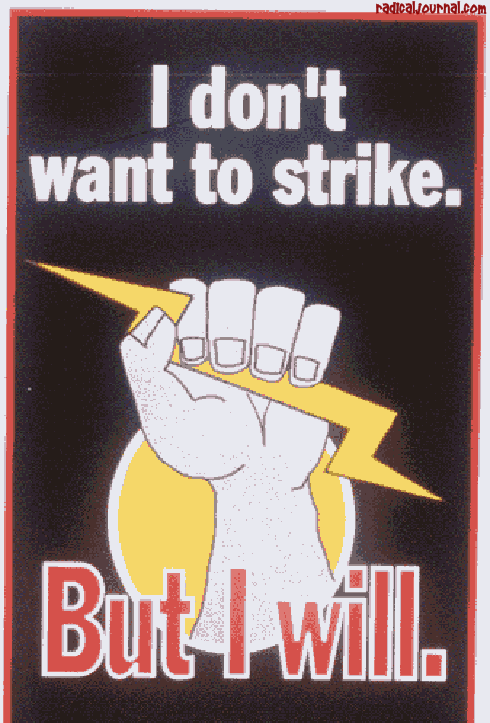
— Teachers in an eastern Pennsylvania school district have gone on strike.
Picket lines were set up Monday outside schools in the East Stroudsburg Area School District, where classes had been canceled earlier until further notice.
The school board criticized the looming strike last week, saying it would accomplish nothing and “will only hurt the students and their families.”
The East Stroudsburg Education Association accused the board of taking a hard stance, saying the teachers had “put forth multiple proposals that are fair and affordable.”
Teachers have been working without a contract for two years, and the two sides remain apart on health care and salary issues.
Below, Evergreen Teachers Association, San Jose
Nurses file lawsuit against Michigan Medicine, threaten work stoppage

Nurses from the University of Michigan Professional Nurses Council are voting this week to consider a work stoppage in protest to what they say are “unfair labor practices” at UM hospitals, clinics and other health care facilities.
The UMPC believes the university is breaking both state and federal law by repeatedly violating the workplace rights of employees, provoking the union to take legal action before the Michigan Employment Relations Commission and in federal court.
Voting to consider authorizing a work stoppage in protest of unfair labor practices, which began on Monday, will continue through Sunday, Sept. 16.
If there are enough votes to legally declare a work stoppage, and the union wishes to proceed with a strike, Michigan Medicine and its members would be given 10 days notice to prepare for any staffing shortages, UMPNC/Michigan Nurses Association Chairwoman Katie Oppenheim said. www.mlive.com/news/ann-arbor/index.ssf/2018/09/nurses_file_lawsuit_against_mi.html
November 28, 2006
The 9/11 Conspiracists and the Decline of the American Left
Where was the American left in the campaign that ended in recapture of both houses of Congress by the Democrats on November 7, 2006? Was it in the streets, fomenting opposition to the war in Iraq? Not at all. The antiwar movement has been inert for months. When I was asked to give the keynote speech at a rare antiwar rally in my local town of Eureka, northern California, in early October, three of my five fellow orators didn’t deign to mention the war at all. Instead they numbed the audience and sharply diminished its size with interminable dissections of the 9/11/2001 attacks on the World Trade Center towers and the Pentagon. Their aim? To argue that the attacks were an “inside job”, organized by Bush and Cheney or (a frequent variation on the theme) darker powers, for whom Bush and Cheney are the mere errand boys.
Five years after the attacks, 9/11 conspiracism has now penetrated deep into the American left. It is also widespread on the libertarian and populist right, but that is scarcely surprising, since the American populist right instinctively mistrusts government to a far greater degree than the left, and matches conspiracies to its demon of preference, whether the Internal Revenue Service, the Federal Emergency Management Agency, Black Helicopters or the Jews.
These days a dwindling number of leftists learn their political economy from Marx via the small, mostly Trotskyist groupuscules. Into the theoretical and strategic void has crept a diffuse, peripatic conspiracist view of the world that tends to locate ruling class devilry not in the crises of capital accumulation, or the falling rate of profit, or inter-imperial competition, but in locale (the Bohemian Grove, Bilderberg, Ditchley, Davos) or supposedly “rogue” agencies, with the CIA still at the head of the list. The 9/11 “conspiracy”, or “inside job”, is the Summa of all this foolishness. www.counterpunch.org/2006/11/28/the-9-11-conspiracists-and-the-decline-of-the-anmerican-left/
Nightmarch by Alpa Shah – among India’s Maoist guerrillas

Between 2008 and 2010, the anthropologist Alpa Shah spent 18 months as a participant observer in India’s largely rural state of Jharkhand. She lived among adivasis, tribal peoples outside the caste system who count among the communities most neglected by the government. Jharkhand is also one of the heartlands of India’s Maoist insurgency, a civil war that in 2006 the country’s prime minister identified as the “biggest internal security threat to the Indian state”. For decades, Indian politicians and commentators have argued about the country’s longstanding Maoist war: are insurgents ideological terrorists fixated on an outdated creed, or are they desperate rebels with a cause, forced to take up guns by state brutality? Dissatisfied by this polarised debate, Shah decided to immerse herself in the communities who live alongside the insurgents, to explore what the rebellion looks like from the grassroots.
This was an exceptional undertaking. The geographic and cultural remoteness of these communities, together with the acute dangers of living in a warzone, mean few outsiders have based themselves there for longer than a few weeks. The lack of careful ethnographic investigation has permitted polemical views of the insurgency to dominate the Indian media. Even more remarkable is the fact that Shah spent her final week in Jharkhand’s forests disguised as a male guerrilla on a 150-mile (240km) trek with a Maoist platoon. Nightmarch – a report of her time with the Maoists and adivasi civilians they govern – provides one the most nuanced, informed accounts yet of this strange and awful conflict.
The civil war is in some ways a cold war anachronism. India’s contemporary Maoists trace their lineage to the Naxalite rebellion of the late 1960s, which was heavily influenced and encouraged by Mao’s Cultural Revolution. While that earlier conflagration was for the most part extinguished in the early 1970s by a harsh state response, splinters of the original movement fought on. In 2004, several of these fragments reunited within a new political and military organisation: the Communist Party of India (Maoist) and its People’s Liberation Guerrilla Army. www.theguardian.com/books/2018/sep/12/nightmarch-alpa-shah-india-maoist-guerrillas-revolutionary-movement
The Little Red Schoolhouse

It’s Time to End Football in High School
More than one million high school students participate in tackle football programs at their schools, during which they each sustain hundreds of violent blows to the head over the course of a season. According to our analysis, the cumulative effect of rattling this many brains this many times is that each year roughly 264,000 high school students suffer traumatic brain injury and cognitive impairment that diminishes their ability to think, learn, and succeed in school. We know this from studies that have correlated the patterns of players’ head blows with traumatic brain injury and cognitive impairment, using helmet sensors, functional MRI brain scans, and tests of working memory.
The biomedical engineering professor Thomas Talavage presented these findings on behalf of the Purdue Neurotrauma Group at a White House summit on sports injuries in 2014. He explained that concussed and non-concussed players alike demonstrate decreased activity in the portions of the brain most vulnerable to impact and have greater difficulty with basic cognitive tasks over the course of a single high school season. About half of the linemen studied and one-quarter of players overall exhibit these symptoms.
As clinical evidence of the risks associated with playing tackle football mounts, professional players and sportscasters have begun to abandon the game. Notably, former NFL linebacker Joshua Perry retired this year after just two seasons, citing concerns over his mounting number of concussions. Some school districts—such as the districts of Maplewood, Mo., and Marshall, Texas—have even begun reducing or canceling tackle football programs. Nevertheless, the many high school students who will continue to play football in the coming school year present school leaders with some serious ethical questions.
Is sponsoring an activity that causes disabling brain injury compatible with educators’ responsibilities to students? Are there compensating educational benefits of playing tackle football that justify the risks? Does the putative consent of players or their parents relieve educators and administrators of their duty to protect students from harm? The answers to these questions are clearly no, no, and no. www.edweek.org/ew/articles/2018/09/11/its-time-to-end-football-in-high.html?cmp=eml-enl-eu-news1&M=58605703&U=1666178
Below, the logical working out of identity politics, the new and corrupt president of San Diego State declares she is the school. Nice work, affirmative action, affirmatively filling the jails with black and brown people and creating the likes of her, Kwame Kilpatrick, and Obama to make oppression acceptable.

SDSU prez De la Torre gets raise to $441,504
Before de la Torre arrived in San Diego, she had been making $313,000 as vice chancellor for student affairs at the University of California Davis, when in 2016 she refused to open her Google email account to investigators for the university who were looking into allegations of improper influence against then-UC Davis president Linda Katehi. “Thus, there may exist relevant communications or documents that were not made available to the investigation team,” per the consultant’s report. On August 9, 2016, Katehi quit after investigators found “numerous instances where Chancellor Katehi was not candid, that she exercised poor judgment, and violated multiple University policies.” www.sandiegoreader.com/news/2018/aug/15/radar-sdsu-prez-de-la-torre-starts-428645/#
A camouflaged ,secret, jury chose to retain the racist Aztec symbol, despite an overwhelming faculty vote.

Michigan school districts battle widespread teacher shortages
Michigan is battling a persistent shortage of teachers early in the school year, prompting school district leaders to scramble to fill their vacancies while fearing the problem might only get worse.
From the Upper Peninsula to Metro Detroit, job postings for K-12 positions across the state advertise hundreds of open positions from foreign language, music, science and math teachers to paraprofessionals to counselors.
While the Michigan Department of Education does not track teacher vacancies among the 900 public school districts in the state — it does publish a critical shortage list that lays out jobs open in multiple districts for retirees — educators in the field report many districts are struggling to fill teaching positions, sometimes for years, as more lucrative jobs in the private sector attract candidates.
“I told my physics teacher to never retire,” said Superintendent Louis Steigerwald of Norway-Vulcan Area Schools in the Upper Peninsula. www.detroitnews.com/story/news/education/2018/09/10/teacher-shortage-michigan-schools/1203975002/
LAUSD chief signals desire to limit teacher job protections and change funding rules
Los Angeles schools Supt. Austin Beutner has yet to lay out his plans to help the nation’s second-largest school district shore up its finances and improve its academics. But on Thursday, in a speech to an invitation-only audience, he gave strong signals that he might fight to place some limits on job protections for teachers and to get Sacramento to change the way it determines funding.
Beutner defended the concept of tenure but expressed dissatisfaction with the results.
“We need a transparent, efficient and fair process to manage ineffective teachers out,” he told the crowd of students, parents, district leaders and representatives of community organizations gathered in the library of the Robert F. Kennedy Community Schools complex in Koreatown. “In the same way we need to support teachers, we need to support students and make sure that they have great teachers in their classrooms.”
Only “a few, a very few, people in the teaching profession are not helping students succeed,” he said, but “an ineffective teacher can cause students to lose more than a year of learning, which is setting students up for failure.” www.latimes.com/local/education/la-me-edu-beutner-teacher-job-protections-20180913-story.html
Teens Are Protesting In-Class Presentations
Some students say having to speak in front of the class is an unreasonable burden for those with anxiety and are demanding alternative options.

For many middle– and high-school students, giving an in-class presentation was a rite of passage. Teachers would call up students, one by one, to present their work in front of the class and, though it was often nerve-racking, many people claim it helped turn them into more confident public speakers.
“Coming from somebody with severe anxiety, having somebody force me to do a public presentation was the best idea to happen in my life,” one woman recently tweeted. According to a recent survey by the Association of American Colleges and Universities, oral communication is one of the most sought-after skills in the workplace, with over 90 percent of hiring managers saying it’s important. Some educators also credit in-class presentations with building essential leadership skills and increasing students’ confidence and understanding of material
But in the past few years, students have started calling out in-class presentations as discriminatory to those with anxiety, demanding that teachers offer alternative options. This week, a tweet posted by a 15-year-old high-school student declaring “Stop forcing students to present in front of the class and give them a choice not to” garnered more than 130,000 retweets and nearly half a million likes. A similar sentiment tweeted in January also racked up thousands of likes and retweets. And teachers are listening. https://www.theatlantic.com/education/archive/2018/09/teens-think-they-shouldnt-have-to-speak-in-front-of-the-class/570061/?utm_source=facebook&utm_campaign=the-atlantic-fb-test-368-3-&utm_content=edit-promo&utm_medium=social
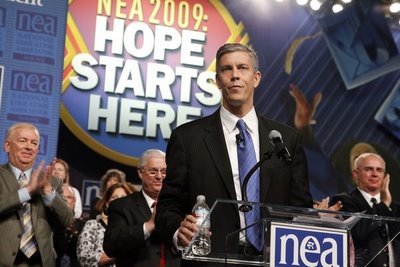
NEA Favorite Arne Duncan has a book!

Year after year, NEA bosses feted Duncan, even if the ranks hated him
The International Hot War of the Rich on the Poor
Seventeen years after Sept. 11, Al Qaeda may be stronger than ever
In the days after Sept. 11, 2001, the United States set out to destroy Al Qaeda. President George W. Bush vowed to “starve terrorists of funding, turn them one against another, drive them from place to place, until there is no refuge or no rest.”
Seventeen years later, Al Qaeda may be stronger than ever. Far from vanquishing the extremist group and its associated “franchises,” critics say, U.S. policies in the Mideast appear to have encouraged its spread.
What U.S. officials didn’t grasp, said Rita Katz, director of the SITE Intelligence Group, in a recent phone interview, is that Al Qaeda is more than a group of individuals. “It’s an idea, and an idea cannot be destroyedusing sophisticated weapons and killing leaders and bombing training camps,” she said.
The group has amassed the largest fighting force in its existence. Estimates say it may have more than 20,000 militants in Syria and Yemen alone.
It boasts affiliates across North Africa, the Levant and parts of Asia, and it remains strong around the Afghanistan-Pakistan border.
It has also changed tactics. Instead of the headline-grabbing terrorist attacks, brutal public executions and slick propaganda used by Islamic State (Al Qaeda’s onetime affiliate and now rival), Al Qaeda now practices a softer approach, embedding itself and gaining the support of Sunni Muslims inside war-torn countries.
Here’s a look at how Al Qaeda has grown in some key Middle Eastern countries:
Iraq
The United States went to war against Iraq in 2003, based in part on the assertion — later debunked — that Al Qaeda had ties to dictator Saddam Hussein.
That claim turned out to be a self-fulfilling prophecy.
In victory, the U.S. disbanded the Iraqi army, putting hundreds of thousands of disgruntled men with military training on the street. Many rose up against what was perceived as a foreign invasion, feeding an insurgency that has never stopped. The insurgency gave birth to Al Qaeda in Iraq, a local affiliate that pioneered the use of terrorist attacks on Shiite Muslims, regarded as apostates by Sunni extremists.
In its 2007 “surge,” the U.S., in concert with pro-government Sunni militias, largely defeated Al Qaeda in Iraq. But by 2010, the group was “fundamentally the same” as it had been before the boost in troops, according to Gen. Ray T. Odierno, the top U.S. commander in Iraq at the time.
The 2011 uprisings in neighboring Syria gave the group the breathing space it needed. Two years later it emerged as Islamic State in Iraq and Syria, also known as ISIS, and split from Al Qaeda’s central leadership.
It also launched an audacious offensive that saw large swaths of Iraq fall into the hands of the jihadists. Although Islamic State has since lost most of its territory, it remains a threat. www.latimes.com/world/middleeast/la-fg-al-qaeda-survive-20180910-story.html
Taliban overruns military base in Zabul
The Taliban has released yet another video showing their fighters gathering in the open after overrunning a military base without fear of reprisal from NATO or Afghan warplanes. In many remote areas of Afghanistan, the Taliban has demonstrated that it can operate virtually unfettered.
The Taliban released “Enemy Retreat from Shomolzo (Zabul)” on Sept. 10 on its official website, Voice of Jihad. It is unclear when the attack took place. In mid-August, the Taliban reportedly killed 11 policemen in Zabul after it overran two checkposts, but the video shows what appears to be a large base. “Shomolzo” is Shamulzayi district, which is contested by the Taliban, according to an assessment by FDD’s Long War Journal.
More footage from Taliban video "Enemy Retreat from Shomolzo (Zabul)" (in Shamulzayi district). As with other videos, note how the large contingent of Taliban fighters is unconcerned about being targeted in retaliatory airstrikes. pic.twitter.com/iX4KmFrs9n
— Bill Roggio (@billroggio) September 12, 2018
Attacks on military bases such as the one in Zabul have become all too common in Afghanistan. Taliban fighters have not paid a price for loitering and celebrating on captured bases or overrun district centers as the Afghan military and Resolute Support are either unwilling or unable to launch airstrikes or retaliatory raids. [See LWJ report, Analysis: Coalition and Afghan forces must target Taliban after overrunning bases, from 2017.]
Resolute Support, NATO’s command in Afghanistan, is recommending that the Afghan military withdraw from more remote outposts, however, this would cede more ground to the Taliban, which in turn leverages these areas to launch attacks on major Afghan population centers. www.longwarjournal.org/archives/2018/09/taliban-overruns-military-base-in-zabul.php?utm_source=feedburner&utm_medium=email&utm_campaign=Feed%3A+LongWarJournalSiteWide+%28FDD%27s+Long+War+Journal+Update%29
Trailblazing female who became infantry Marine is getting kicked out for fraternization
/arc-anglerfish-arc2-prod-mco.s3.amazonaws.com/public/7535ZS75RZH37AGDIFMZCTUE44.jpg)
Remedios Cruz joined the Marine Corps in 2013 as a supply clerk. One year later, she completed infantry training, and in 2017, made history when she became one of three females to join 1st Battalion, 8th Marines at Camp Lejeune, North Carolina.
Now, Cruz is awaiting separation from the Marine Corps after pleading guilty to maintaining a romantic relationship with a subordinate.
Cruz, 26, eventually married the person, who was a lower-ranking Marine in her unit, according The New York Times.
“The biggest mistakes I’ve made in the infantry were from my personal relationships,” Cruz told the Times. “I really want to move on.” www.marinecorpstimes.com/news/your-marine-corps/2018/09/12/trailblazing-female-who-became-infantry-marine-is-getting-kicked-out-for-fraternization/?utm_source=facebook.com&utm_campaign=Socialflow+MAR&utm_medium=social

Watchdog report: The VA benefits backlog is higher than officials say
The benefits backlog at Veterans Affairs is worse than leaders there have acknowledged, according to a new investigation from the department’s top watchdog.
In a report released Monday, the VA inspector general found tens of thousands of benefits cases omitted or ignored by department officials that “significantly understated the number of claims awaiting decisions for over 125 days.”
Investigators estimated that the reported backlog only covers about 79 percent of relevant cases, with a host of others misclassified, mistakenly excluded and, in some cases, only acknowledged as overdue after the files had finally been processed.
In response, VA officials said they are “reviewing how best to supplement or adjust reporting on the rating-related backlog.” New training and standards are expected to be put in place by the end of this year.
The VA claims backlog was a major scandal during President Barack Obama’s administration, as frustrations grew over the slow pace of VA’s ability to handle an ever-growing number of disability claims. www.militarytimes.com/news/2018/09/10/watchdog-report-the-va-benefits-backlog-is-higher-than-officials-say/
McRaven, former SOCOM head, resigns from Pentagon board following Trump criticism
— William McRaven, the retired four-star admiral who led U.S. Special Operations Command from 2011 to 2014, has resigned from the Pentagon’s technology advisory board following a public critique of President Donald Trump, Defense News has learned.
McRaven resigned from the Defense Innovation Board, a group of technology leaders and innovators tasked with advising the secretary of defense on pertinent issues, on Aug. 20, four days after he posted a scathing op-ed in the Washington Post calling out Trump for revoking the security clearance of former CIA director John Brennan.
Through your actions, you have embarrassed us in the eyes of our children, humiliated us on the world stage and, worst of all, divided us as a nation,” McRaven wrote to Trump in the Post. “If you think for a moment that your McCarthy-era tactics will suppress the voices of criticism, you are sadly mistaken. The criticism will continue until you become the leader we prayed you would be.”
McRaven’s photo has been removed from the DIB website, and Lt. Col. Michelle Baldanza, a Pentagon spokeswoman, confirmed that McRaven resigned from his post on the DIB. She added that “The Department appreciates his service and contribution on the board.”
Created by then-Secretary of Defense Ash Carter in 2016, the DIB is made up primarily of tech thinkers from outside the military. While big names such as former Alphabet head Eric Schmidt and astrophysicist Neil deGrasse Tyson helped gain it attention, the board benefited early by the presence of McRaven, who remained well-respected within the department. www.defensenews.com/pentagon/2018/09/13/mcraven-former-socom-head-resigns-from-pentagon-board-following-trump-criticism/?utm_source=Sailthru&utm_medium=email&utm_campaign=ebb%2014.09.18&utm_term=Editorial%20-%20Military%20-%20Early%20Bird%20Brief
Top 100 Defense Companies for 2018
people.defensenews.com/top-100/
A Former Navy official pleads guilty in ‘Fat Leonard’ probe just weeks after indictment
Three weeks after being indicted in the “Fat Leonard” Navy bribery probe, a former Navy official on Wednesday admitted to helping steer military business to a contractor in exchange for kickbacks.
Ricarte Icmat David, 61, a former master chief petty officer from 2003 to 2012, pleaded guilty in San Diego federal court to one count of conspiracy to commit honest services fraud.
David was among three retired Navy officials to be indicted last month, the latest batch in an investigation that has netted 32 people and shows no sign of ending anytime soon.
Like many of the officials targeted by Navy contractor Leonard Glenn Francis, David worked in logistics in the 7th Fleet in Southeast Asia. The investigation shows Francis, nicknamed for his girth, kept a rotating list of military members on his payroll and would lean on them for ship movement schedules, proprietary negotiations on contracts and even intelligence about investigations into his business practices.
Francis has admitted to overbilling the Navy some $35 million for services that his husbanding firm, Glenn Defense Marine Asia, provided visiting military ships, such as trash removal, water and security.
David admitted in his plea agreement to approving inflated invoices for port visits.
According to the indictment, David was rewarded with hotel rooms, prostitutes and $40,000 in cash — much of which apparently went to build a home in the Philippines where he now lives. The plea agreement, however, does not mention prostitutes and characterizes the cash bribes as “more than one” and “totaling more than $15,000.” www.sandiegouniontribune.com/news/courts/sd-me-david-plea-20180905-story.html
The International Economic War of the Rich on the Poor
Rising Student loan debt from 2008. Now nearing $1.6 trillion


The Next Financial Calamity Is
Coming. Here’s What to Watch.
The global financial crisis is fading into history. But the roots of the next one might already be taking hold.
Financial crises strike rich countries every 28 years on average. Often, the break between busts is much shorter.
Fast-growing pockets of debt, as in the last time around, look like potential sources of problems. They’re nowhere near as big as the mortgage bubble, and no blow-ups appear imminent.
“But what we saw last time around is that things can creep up on you,” said Wesley Phoa, a bond-fund manager at the Capital Group. “You can turn around and in three years’ time you can go from not much of a problem to a pretty big problem.”
The amount of American student debt — roughly $1.5 trillion — has more than doubled since the financial crisis. It is now the second-largest category of consumer debt outstanding, after mortgages.
Public colleges and universities, hurt by state budget cuts, increased tuition. The drop in house values also made it harder for families to tap into their home equity to pay for tuition. As a result, the financial burden shifted to students, who took on heavier debt loads to pay for school.
Many borrowers are already falling behind. During the second quarter of 2018, more than 10 percent of student loans were at least 90 days past due. That was down slightly from a couple of years ago, but higher than the peak for mortgage delinquencies during the last crisis.
Companies are also loading up on debt
After the crisis, central banks slashed their interest rates. Investors moved their money out of government bonds, which were paying essentially nothing. And they piled into corporate bonds, which typically pay slightly higher rates.
American companies were more than happy to satisfy investors’ ravenous appetites — and they did so by selling gobs of debt. (much more: www.nytimes.com/interactive/2018/09/12/business/the-next-recession-financial-crisis.html?action=click&module=Top%20Stories&pgtype=Homepage)
The Recovery Threw the Middle-Class Dream Under a Benz
Once a year or so, the economist Diane Swonk ventures into the basement of her 1891 Victorian house outside Chicago and opens a plastic box containing the items that mean the most to her: awards, wedding pictures, the clothes she was wearing at the World Trade Center on the day it was attacked. But what she seeks out again and again is a bound diary of the events of the financial crisis and their aftermath.
“It’s useful to go back and see what a chaotic time it was and how terrifying it was,” she said. “That time is seared in my mind. I looked at it again recently, and all the pain came flooding back.”
A decade later, things are eerily calm. The economy, by nearly any official measure, is robust. Wall Street is flirting with new highs. And the housing market, the epicenter of the crash, has recovered in many places. But like the diary stored in Ms. Swonk’s basement, the scars of the financial crisis and the ensuing Great Recession are still with us, just below the surface.
The most profound of these is that the uneven nature of the recovery compounded a long-term imbalance in the accumulation of wealth. As a consequence, what it means to be secure has changed. Wealth, real wealth, now comes from investment portfolios, not salaries. Fortunes are made through an initial public offering, a grant of stock options, a buyout or another form of what high-net-worth individuals call a liquidity event.
Data from the Federal Reserve show that over the last decade and a half, the proportion of family income from wages has dropped from nearly 70 percent to just under 61 percent. It’s an extraordinary shift, driven largely by the investment profits of the very wealthy. In short, the people who possess tradable assets, especially stocks, have enjoyed a recovery that Americans dependent on savings or income from their weekly paycheck have yet to see. Ten years after the financial crisis, getting ahead by going to work every day seems quaint, akin to using the phone book to find a number or renting a video at Blockbuster.
The financial crisis didn’t just kill the dream of getting rich from your day job. It also put an end to a fundamental belief of the middle class: that owning a home was always a good idea because prices moved in only one direction — up…
In 2016, net worth among white middle-income families was 19 percent below 2007 levels, adjusted for inflation. But among blacks, it was down 40 percent, and Hispanics saw a drop of 46 percent. For many, old-fashioned hard work has simply not been a viable path out of this hole. After unemployment peaked in the fall of 2009, it took years for joblessness to return to pre-recession levels. Slack in the labor market left the employed and unemployed alike with little leverage to demand raises, even as corporate profits surged. www.nytimes.com/2018/09/12/business/middle-class-financial-crisis.html?action=click&module=Top%20Stories&pgtype=Homepage
Ten years after the crash: have the lessons of Lehman been learned?
Risk has not been diminished, just taken out of sight
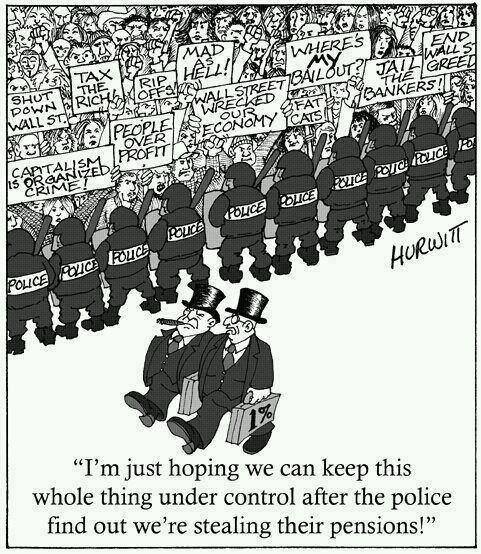
Ten years after its near-death experience, capitalism is back to its old ways.
Bailouts for the few and austerity for the many have caused global debt to rise 40% since 2007. Yes, British and European banks have contracted (as US authorities required Barclays, Deutsche Bank etc to shrink their dollar business) and tougher national rules constrain balance sheets.
However, this has causedfinancial intermediation to shift from banks to capital markets. By making some banks safer, the risk has been moved to the shadow banking system, which has grown from $28tn in 2010 to $45tn in 2018, and from the west to emerging markets, which have borrowed $3.7tn in the last decade – with the results we now see in Turkey and Argentina. In short, risk has not been diminished, just taken out of sight and dispersed geographically. Moreover, toxic politics has ensured that the two states that saved capitalism in 2008, the US and China, cannot repeat that double act. …www.theguardian.com/commentisfree/2018/sep/14/the-panel-lehman-brothers-ten-year-anniversary-financial-crash

A Mediocre Financial Crisis Reading List that makes one important point (Bush=Obama on bailing out banks)

I suspect that authors covering the broader sweep will note the remarkable continuity of crisis efforts across the two presidential administrations. Policies to stabilize the financial system included the TARP capital injections into banks, debt guarantees from the F.D.I.C. and targeted interventions into particular markets and industries by the Fed and the Treasury Department. These latter efforts stabilized money market mutual funds (including actions by the Treasury and the Fed); commercial paper markets (Fed); securitized lending (Treasury and Fed); the auto industry (Treasury); and individual entities like A.I.G., Citigroup, Bank of America, Fannie Mae and Freddie Mac (Treasury and Fed).
In a Feb. 24, 2009, address to Congress, President Obama said that he was “infuriated by the mismanagement and the results” of the assistance for struggling banks. And yet the financial rescue programs listed above were begun before Jan. 20, 2009, and continued by the Obama administration. On top of these efforts would be added the quantitative easing purchases of Treasury bonds and mortgage-backed securities first announced by the Fed in late November 2008 and now in a third round. The early 2009 fiscal stimulus was an Obama innovation, but its effectiveness remains the subject of considerable debate.
President Obama has received considerable criticism lately for continuing a range of Bush-era security policies. An irony, then, is that this observation applies as well to the financial policy crisis response. As detailed in the books above, these efforts did not head off the Great Recession, but on the whole they succeeded in stabilizing the financial system and avoiding an even worse catastrophe. (NYT, July 15, 2013)
8/12/2011 3:05PM
Nouriel Roubini: Karl Marx Was Right

In a clip from a longer interview with WSJ’s Simon Constable, Dr Nouriel Roubini claims Karl Marx was right about capitalism self-destructing. While the U.S. is not there yet, he believes there is considerable danger facing the United States. Video in link.
www.wsj.com/video/nouriel-roubini-karl-marx-was-right/68EE8F89-EC24-42F8-9B9D-47B510E473B0.html
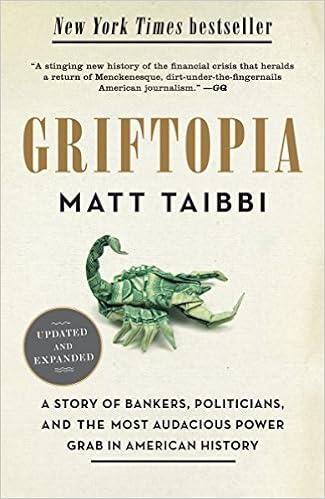
Matt Taibbi here unravels the whole fiendish story, digging beyond the headlines to get into the deeper roots and wider implications of the rise of the grifters. He traces the movement’s origins to the cult of Ayn Rand and her most influential—and possibly weirdest—acolyte, Alan Greenspan, and offers fresh reporting on the backroom deals that decided the winners and losers in the government bailouts. He uncovers the hidden commodities bubble that transferred billions of dollars to Wall Street while creating food shortages around the world, and he shows how finance dominates politics, from the story of investment bankers auctioning off America’s infrastructure to an inside account of the high-stakes battle for health-care reform—a battle the true reformers lost. Finally, he tells the story of Goldman Sachs, the “vampire squid wrapped around the face of humanity.” www.bookscrolling.com/best-books-learn-financial-crisis/
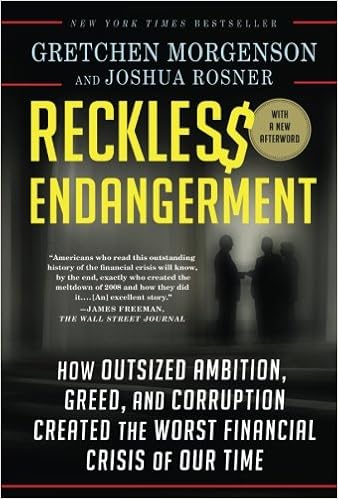
Morgenson and Rosner draw back the curtain on Fannie Mae, the mortgage-finance giant that grew, with the support of the Clinton administration, through the 1990s, becoming a major opponent of government oversight even as it was benefiting from public subsidies. They expose the role played not only by Fannie Mae executives but also by enablers at Countrywide Financial, Goldman Sachs, the Federal Reserve, HUD, Congress, the FDIC, and the biggest players on Wall Street, to show how greed, aggression, and fear led countless officials to ignore warning signs of an imminent disaster.
I Saw the Crisis Coming. Why Didn’t the Fed?
By mid-2005, I had so much confidence in my analysis that I staked my reputation on it. That is, I purchased credit default swaps — a type of insurance — on billions of dollars worth of both subprime mortgage-backed securities and the bonds of many of the financial companies that would be devastated when the real estate bubble burst. As the value of the bonds fell, the value of the credit default swaps would rise. Our swaps covered many of the firms that failed or nearly failed, including the insurer American International Group and the mortgage lenders Fannie Mae and Freddie Mac.

I entered these trades carefully. Suspecting that my Wall Street counterparties might not be able or willing to pay up when the time came, I used six counterparties to minimize my exposure to any one of them. I also specifically avoided using Lehman Brothers and Bear Stearns as counterparties, as I viewed both to be mortally exposed to the crisis I foresaw.
What’s more, I demanded daily collateral settlement — if positions moved in our favor, I wanted cash posted to our account the next day. This was something I knew that Goldman Sachs and other derivatives dealers did not demand of AAA-rated A.I.G.
I believed that the collapse of the subprime mortgage market would ultimately lead to huge failures among the largest financial institutions. But at the time almost no one else thought these trades would work out in my favor.

During 2007, under constant pressure from my investors, I liquidated most of our credit default swaps at a substantial profit. By early 2008, I feared the effects of government intervention and exited all our remaining credit default positions — by auctioning them to the many Wall Street banks that were themselves by then desperate to buy protection against default. This was well in advance of the government bailouts. Because I had been operating in the face of strong opposition from both my investors and the Wall Street community, it took everything I had to see these trades through to completion. Disheartened on many fronts, I shut down Scion Capital in 2008.
Since then, I have often wondered why nobody in Washington showed any interest in hearing exactly how I arrived at my conclusions that the housing bubble would burst when it did and that it could cripple the big financial institutions. A week ago I learned the answer when Al Hunt of Bloomberg Television, who had read Michael Lewis’s book, “The Big Short,” which includes the story of my predictions, asked Mr. Greenspan directly. The former Fed chairman responded that my insights had been a “statistical illusion.” Perhaps, he suggested, I was just a supremely lucky flipper of coins.
Mr. Greenspan said that he sat through innumerable meetings at the Fed with crack economists, and not one of them warned of the problems that were to come. By Mr. Greenspan’s logic, anyone who might have foreseen the housing bubble would have been invited into the ivory tower, so if all those who were there did not hear it, then no one could have said it. www.nytimes.com/2010/04/04/opinion/04burry.html
In one of the most gripping financial narratives in decades, Andrew Ross Sorkin-a New York Times columnist and one of the country’s most respected financial reporters-delivers the first definitive blow- by-blow account of the epochal economic crisis that brought the world to the brink. Through unprecedented access to the players involved, he re-creates all the drama and turmoil of these turbulent days, revealing never-before-disclosed details and recounting how, motivated as often by ego and greed as by fear and self-preservation, the most powerful men and women in finance and politics decided the fate of the world’s economy. (But really, Sorkin loves the banksters)

US Commission on the Financial Crisis: Dissenting Position (27 pages)
CAUSES OF THE
FINANCIAL AND ECONOMIC CRISIS
CONTENTS
Introduction………………………………………………………………………………………….
How Our Approach Differs from Others’ ………………………………………………….
Stages of the Crisis………………………………………………………………………………….
The Ten Essential Causes of the Financial and Economic Crisis……………………
The Credit Bubble: Global Capital Flows, Underpriced Risk,
and Federal Reserve Policy………………………………………………………………………
The Housing Bubble ………………………………………………………………………………
Turning Bad Mortgages into Toxic Financial Assets ……………………………………
Big Bank Bets and Why Banks Failed……………………………………………………….
Two Types of Systemic Failure………………………………………………………………….
The Shock and the Panic…………………………………………………………………………
The System Freezing ………………………………………………………………………………
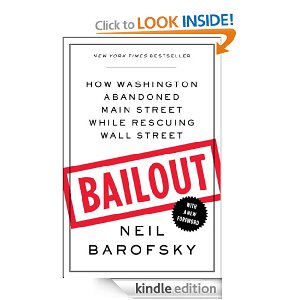 Neil Barofsky served as the Special Inspector General in charge of overseeing TARP from December 2008 until March 2011. For eight years prior, he was a federal prosecutor in the US Attorney’s Office for the Southern District of New York, during which time he headed the Mortgage Fraud Group. Currently, Neil Barofsky is a senior fellow at New York University School of Law. An alum of the University of Pennsylvania and the New York University School of Law, this is his first book.
“In his scathing new book, Barofsky says taxpayers got shafted while the rich got richer… a true expose…. Taxpayers who feel helpless in the midst of the extended economic recession are likely to feel energized to metaphorically blow up the system after reading Barofsky’s account.” (St. Louis Post-Dispatch)
Ten Years After the Crash, We’ve Learned Nothing

Ten years ago, on Saturday, September 13th, 2008, the world was about to end.
The New York Federal Reserve was a zoo. Imagine NASA headquarters on the day a giant asteroid careens into the atmosphere. That was the New York Fed: all hands on deck, peak human panic.
The crowd included future Treasury Secretary Timothy Geithner, then-Treasury Secretary (and former Goldman Sachs CEO) Hank Paulson, the representatives of multiple regulatory offices, and the CEOs of virtually every major bank in New York, each toting armies of bean counters and bankers.
Persistent propaganda about what happened 10 years ago not only continues to warp news coverage, but contributed to a wide array of political consequences, including the election of Donald Trump.
The most persistent myths about 2008:
Myth#1: The crash was an accident www.rollingstone.com/politics/politics-features/financial-crisis-ten-year-anniversary-723798/
But what is left out of this bourgie list of capitalist apologists? Marx.
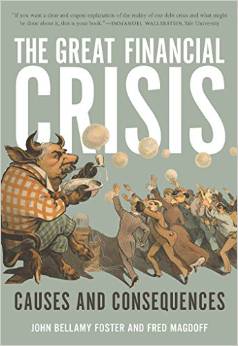 and the best book on the 1929 Depression is online, free. Even a read of the first two chapters should get any beginner going.
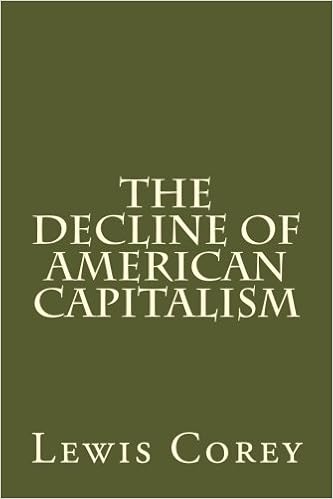
www.marxists.org/archive/corey/1934/decline/index.html
U.S. Recovery Eludes Many Living Below Poverty Level, Census Suggests

In July, President Trump’s Council of Economic Advisers declared that the country’s five-decade war on poverty was largely over and called it a success.
On Wednesday, the Census Bureau released its 2017 annual report on the poor that offered a stark counterpoint, suggesting that the national recovery has bypassed many of the 40 million to 45 million Americans estimated to be living below the federal poverty level.
While median household income rose 1.8 percent last year, the national poverty rate remained stubbornly high at 12.3 percent. That was just a slight decrease from the previous year’s level of 12.7 percent, according to the federal government’s most comprehensive annual gauge of economic hardship.
The supplemental poverty measure for 2017, widely regarded by economists as more accurate, was even higher, 13.9 percent in 2017, essentially unchanged from the year before. That is an improvement from the recent high of 16 percent recorded in 2013. But economists and advocates for poor people say the relatively modest gains over the last few years are fragile, endangered by the Trump administration’s policies and vulnerable to a long-overdue economic downturn. www.nytimes.com/2018/09/13/us/politics/poverty-rate-census-bureau.html
Even in Better Times, Some Americans Seem Farther Behind. Here’s Why.
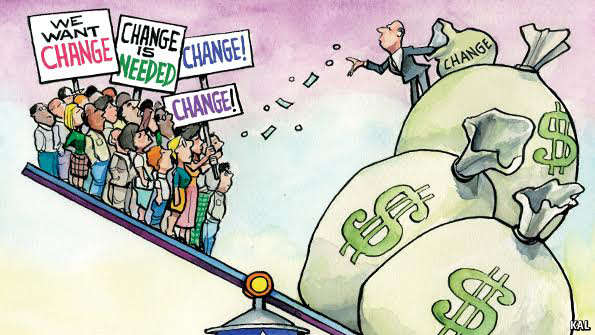
Americans’ household earnings are finally stretching back to their pre-recession heights. But feeling secure and comfortable isn’t only a measure of how much money you have. It’s also a measure of how much you have compared with others.
For many, that is one reason that recent financial progress may seem overshadowed by the gains they’ve missed out on and a needling sense that they’ve lost ground.
As new research illustrates, two groups in particular have stalled: whites without a college degree, and blacks and Hispanics with one. Both are being far outpaced by college-educated whites.
“America has been a story of getting ahead, of progress,” said Morris P. Fiorina, a political scientist at Stanford University. “There’s been no story of progress — for them.”
The findings, part of a study on the demographics of wealth between 1989 and 2016 from the Federal Reserve Bank of St. Louis, show significant advances in education and earnings among white, black and Hispanic Americans over that period. A Census Bureau report this week also showed continued income gains last year. But the study highlights the growing importance of relative shifts in position up or down the income ladder at a time when the economy’s riches are flowing increasingly to the wealthiest sliver.
The economic swoops and comebacks of the last three decades have chipped away at many measures of well-being. An advanced global economy has radically revalued the contributions of blue-collar labor and technological skills.
The lingering economic insecurity has fired resentments, sharpened identity politics and fueled populism on the right and left that is upending hierarchies in the Democratic and Republican Parties.
But parallels between whites who did not finish college and blacks and Hispanics who did show that “this is not clearly a race story and not clearly an education story,” said William R. Emmons, an economist at the St. Louis Fed and a co-author of its report. To Mr. Emmons, the most striking result was the steep declines among white families headed by someone without a college degree. Members of this group — labeled the white working class — not only were left behind financially, but also lagged in other measures of well-being, like self-reported health, homeownership, and marriage or cohabitation rates. www.nytimes.com/2018/09/14/business/economy/income-inequality.html
We allow the rich to escape charges, admits taxman

HM Revenue & Customs (HMRC) has admitted for the first time that it allows the most powerful members of society to escape prosecution for financial crimes.
At an economic crime conference in Cambridge last week, a senior government official admitted that the tax authorities accommodated celebrities’ concerns and settled debts privately to avoid the embarrassment of a public trial.
HMRC, however, continues to prosecute smugglers, small businesses and benefits cheats.
Richard Las, the deputy director of HMRC in charge of organised crime, said that “very wealthy and prominent members of the community” were afraid of the “reputational damage” that a criminal trial for fraud, money-laundering or tax evasion would bring. www.thetimes.co.uk/article/we-allow-the-rich-to-escape-charges-admits-taxman-pb307srkq
JPMorgan Predicts the Next Financial Crisis Will Strike in 2020
How bad will the next crisis be? JPMorgan Chase & Co. has an idea.
A decade after the collapse of Lehman Brothers sparked a plunge in markets and a raft of emergency measures, strategists at the bank have created a model aimed at gauging the timing and severity of the next financial crisis. And they reckon investors should pencil it in for 2020.
The good news is, the next one will probably generate a somewhat less painful hit than past episodes, according to their analysis. The bad news? Diminished financial market liquidity since the 2008 implosion is a “wildcard” that’s tough to game out.
The JPMorgan model calculates outcomes based on the length of the economic expansion, the potential duration of the next recession, the degree of leverage, asset-price valuations and the level of deregulation and financial innovation before the crisis. Assuming an average-length recession, the model came up with the following peak-to-trough performance estimates for different asset classes in the next crisis, according to the note.
- A U.S. stock slide of about 20 percent.
- A jump in U.S. corporate-bond yield premiums of about 1.15 percentage points.
- A 35 percent tumble in energy prices and 29 percent slump in base metals.
- A 2.79 percentage point widening in spreads on emerging-nation government debt.
- A 48 percent slide in emerging-market stocks, and a 14.4 percent drop in emerging currencies.
“Across assets, these projections look tame relative to what the GFC delivered and probably unalarming relative to the recession/crisis averages” of the past, JPMorgan strategists John Normand and Federico Manicardi wrote, noting that during the recession and ensuing global financial crisis the S&P 500 fell 54 percent from its peak. “We would nudge them all at least to their historical norms due to the wildcard from structurally less-liquid markets.” www.bloomberg.com/news/articles/2018-09-13/jpmorgan-sees-liquidity-wildcard-in-gauging-depth-of-next-crisis?cmpid=BBD091418_MKT&utm_medium=email&utm_source=newsletter&utm_term=180914&utm_campaign=marketsasia
The Emergence of Fascism as a Popular Mass Movement and The War on Reason

Mephistopheles
The Racism Inside Fire Departments
When we firefighters step into a life-threatening situation, we need to work as a team. Hate and discrimination within our ranks make that impossible.

Imagine how you would feel if you showed up at work and found a noose waiting for you. It happened just last year to a young black firefighter in Miami. In our profession, that garish expression of racism was unfortunately not an anomaly. In the aftermath of California’s summer wildfires and the well-deserved praise of the heroism of the people who risked their lives to extinguish them, it’s also important to confront the bigotry that puts individual firefighters and the people we serve at risk.
I’ve served 35 years as a firefighter, and the racism today is as bad as I can remember. My organization, the International Association of Black Professional Firefighters, is monitoring or pursuing legal or administrative action on a dozen major cases of discrimination.
Though the noose incident took place in Florida, this is not just a Southern problem. Complaints come from liberal bastions including New York City, where just last year seven African-American employees of the Fire Department filed a lawsuit over “a broad pattern of racial discrimination.” In Ohio, a volunteer firefighter announced on Facebook that he’d rather save a dog than an African-American. Beyond the obvious implications for citizens who might need help, this statement is representative of the kind of attitude many black firefighters confront at work each day. www.nytimes.com/2018/09/12/opinion/the-racism-inside-fire-departments.html?action=click&module=Opinion&pgtype=Homepage
Obama’s Imperial Presidency
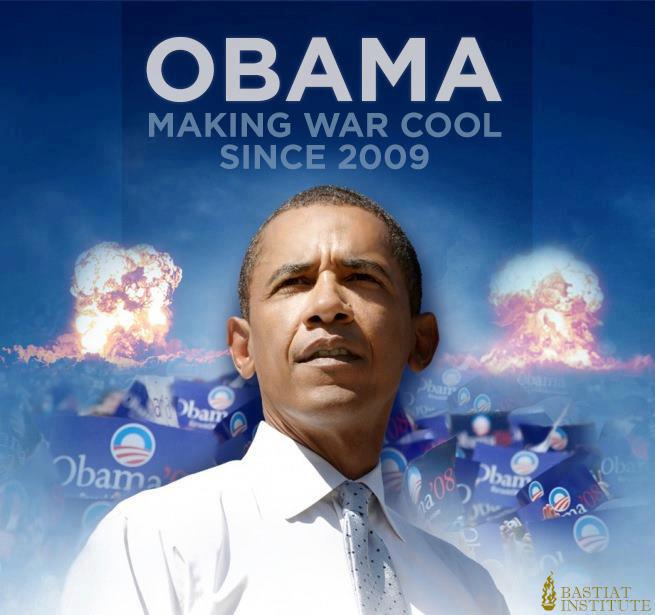
…Obama, it turns out, was among the most militaristic White House occupants in American history, taking the imperial presidency to new heights. It has been said that Obama was the only president whose administration was enmeshed in multiple wars from beginning to end. His imperial ventures spanned many countries – Afghanistan, Iraq, Syria, Libya, Somalia along with proxy interventions in Yemen and Pakistan. He ordered nearly 100,000 bombs and missiles delivered against defenseless targets, a total greater than that of the more widely-recognized warmonger George W. Bush’s total of 70,000 against five countries. Iraq alone – where U.S. forces were supposed to have been withdrawn – was recipient of 41,000 bombs and missiles along with untold amounts of smaller ordnance. Meanwhile, throughout his presidency Obama conducted hundreds of drone attacks in the Middle East, more than doubling Bush’s total, all run jointly (and covertly) by the CIA and Air Force.
Obama engineered two of the most brazen regime-change operations of the postwar era, in Libya (2011) and Ukraine (2014), leaving both nations reduced to a state of ongoing civil war and economic ruin.
Solidarity for Never
South African communists ‘unrelentingly opposed’ to release of Chris Hani’s murderer
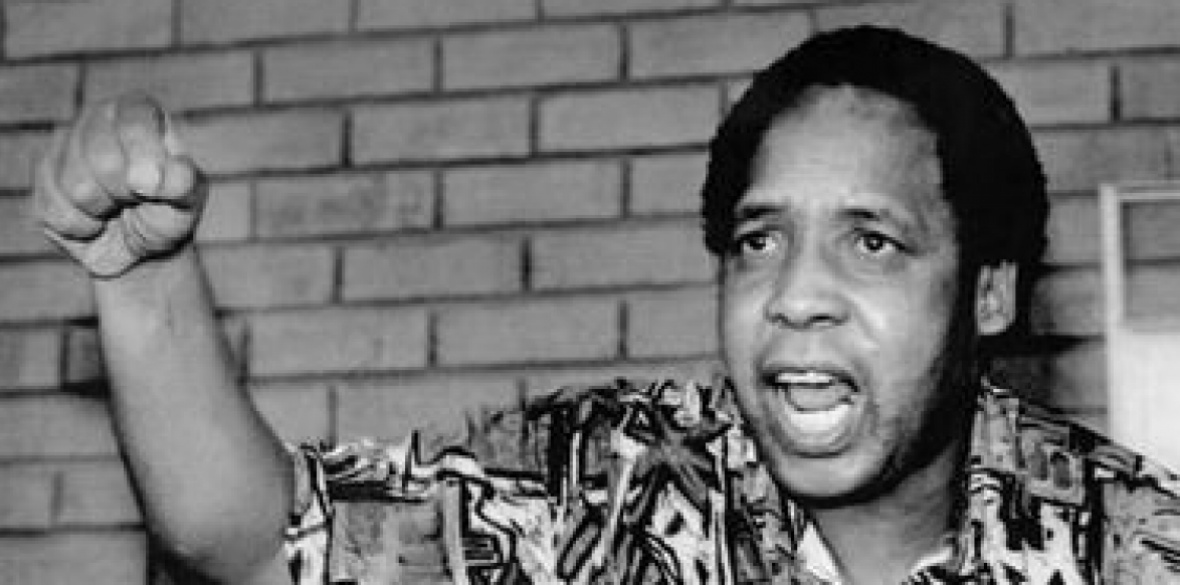
SOUTH African communists (SACP) remain unrelentingly opposed to the release from jail of Janusz Walus, who murdered their general secretary Chris Hani, party spokesman Alex Mashilo confirmed today.
“The assassin says he does not regret assassinating Chris Hani the communist, but the husband and father. This is nothing but an intransigent refusal to show remorse,” he said.
“Hani was an indivisible person. Hani the husband and father was the same person as Hani the communist. Walus’s assassination of Hani the communist was in all material respects the assassination of Hani the husband and father. www.morningstaronline.co.uk/article/south-african-communists-unrelentingly-opposed-release-chris-hanis-murderer
Why Does the Detroit Federation of Teachers Exist?

To Sign Up for Dues Collection Visit: Join.AFT.org
Detroit Federation of Teachers
7700 Second Ave. Suite 427
Detroit, MI 48202-2411
Phone: (313) 875-3500
Spy versus Spy
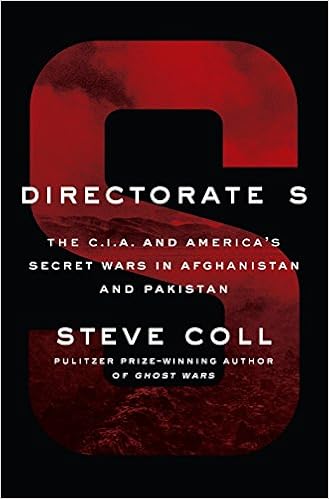
Coll discusses Directorate S on Cspan
www.c-span.org/video/?449746-29/steve-coll-discusses-directorate-s&playEvent
The Magical Mystery Tour
The shadowy extremist sect accused of plotting to kill intellectuals in India
BANGALORE, India — The killers trailed her for months, watching her every move. When the day came, they were ready for her.
Journalist Gauri Lankesh had locked up the office of her scrappy weekly newspaper and had just returned home here when the killers arrived on a motorcycle.
One of them — his face obscured by a helmet — drew close and began shooting. One, two, three shots. Lankesh tried to flee, but the last bullet ended her life.
The journalist’s death a year ago reverberated across India. She was given a state funeral in Bangalore, and thousands marched in protest around the country, chanting, “I am Gauri. We are all Gauri.” Many thought Lankesh was killed because of her outspoken criticism against the government and rising right-wing extremism.
Police investigating the slaying think her death was part of a wider conspiracy, with evidence linking her killing to three other meticulously planned slayings of secular intellectuals since 2013. They say Lankesh’s killers were associated with Sanatan Sanstha, a shadowy extremist religious sect that has been accused of using hypnotherapy to incite its followers to kill those they consider enemies of Hinduism. Investigators uncovered a hit list of more than two dozen other writers and scholars.
The hit list and the accusations against members of Sanatan Sanstha have frightened intellectuals and raised concerns about freedom of expression in the world’s largest democracy at a time when violence by fringe Hindu extremist groups — many of whom helped propel India’s governing Hindu nationalist Bharatiya Janata Party to power — appears to be rising. www.washingtonpost.com/world/asia_pacific/the-shadowy-extremist-sect-accused-of-plotting-to-kill-intellectuals-in-india/2018/09/06/d7f78514-a66a-11e8-ad6f-080770dcddc2_story.html?utm_term=.983c6130e5f0
San Diego’s Catholic diocese adds eight priests to list of sexual predators
..The new names — the Revs. Jose Chavarin, Raymond Etienne, J. Patrick Foley, Michael French, Richard Houck, George Lally and Paolino Montagna, plus Monsignor Mark Medaer — were released in piecemeal fashion, with critical details missing.
This list extends the roster of predator priests established by a landmark legal case that was concluded 11 years ago. On Sept. 7, 2007, the diocese settled 144 claims of child sexual abuse by 48 priests and one lay employee. The payments totaled $198.1 million, the second-largest settlement by a Catholic diocese in the United States….
“They’re telling me that there are now 56 priests who are credibly accused of sexual abuse in San Diego?” asked Patrick Wall, a former priest who now investigates clerical sexual misconduct for a Minnesota law firm, Jeff Anderson and Associates. “I believe that number to be extremely short.” (see some of the very sharp comments) www.sandiegouniontribune.com/news/religion/sd-me-abusive-priests-20180906-story.html
German Catholic priests abused thousands of children

More than half of the victims were younger than 13 and predominantly male, a new report has shown. The study’s findings were based on documented cases that occurred over more than six decades.
A study commissioned by the German Bishops Conference examined 3,677 cases of abuse allegedly perpetrated by clergy nationwide, German magazine Der Spiegel reported on Wednesday. The universities of Giessen, Heidelberg and Mannheim were involved in the research, which implicated 1,670 priests in sexual abuse spanning from 1946 to 2014.
The report comes amidst a resurfacing of abuse and cover-up allegations against the Catholic Church around the world. Pope Francis has apologized and pledged to support victims in their search for justice, but he has also been singled out for inaction against abuser priests in the past.
The victims in Germany were predominantly male and more than half of them were 13 years of age or younger. Every sixth case involved a rape, and in three-quarters of the cases, the victim and perpetrator knew each other through the church.
‘Dismayed and ashamed’
“We know the extent of the sexual abuse that has been demonstrated by the study. We are dismayed and ashamed by it,” said Bishop Stephan Ackermann on behalf of the Bishop’s Conference.
The purpose of the study, Ackermann said, was to shine a light on “this dark side of our Church, for the sake of those affected, but also for us ourselves to see the errors and to do everything to prevent them from being repeated.”
More cases could exist, the study cautions, noting that the figures represent a conservative estimate. www.dw.com/en/german-catholic-priests-abused-thousands-of-children/a-45459734
Beth Israel Chaplain Accused Of Sexually Abusing A Child

BOSTON (CBS) – A priest who served at a church in Brookline and as a chaplain at a Boston hospital is accused of sexually abusing a child. Rev. Christian Ohazulume of Nigeria pleaded not guilty to three counts of aggravated and indecent assault and battery on a child under the age of 14.
Ohazulume has been a chaplain at Beth Israel Deaconess Medical Center since 2010, according to the Archdiocese of Boston. During that time, he has also lived at St. Mary of the Assumption Parish in Brookline where he’s assisted in celebrating Mass and hearing confessions.
The Archdiocese said they received “an allegation of sexual abuse of a child on August 31.” They say they alerted police and later removed Ohazulume from ministry.
“The allegation was identified to have occurred in 2007, during a time he was residing with a family upon his arrival in the United States,” the Archdiocese said in a statement Tuesday.
The Norfolk District Attorney’s Office said the charges were taken by Randolph Police.
“The Archdiocese was advised by law enforcement to delay until today release of this information while they initiated their investigation,” the archdiocese said in its statement. boston.cbslocal.com/2018/09/11/christian-ohazulume-beth-israel-deaconess-medical-center-chaplain-boston-priest-sex-abuse-allegation-randolph-police-brookline/

Cardinal Cupich of Chicago says sex abuse in Church is a “distraction”
Statement by Tim Lennon, President of SNAP, tlennon@SNAPnetwork.org, 415-312-5820
Cardinal Blase Cupich recently told a group of seminarians that “while the church’s ‘agenda’ certainly involves protecting kids from harm, we have a bigger agenda than to be distracted by all of this.” The cardinal also added, “I feel very much at peace at this moment. I am sleeping OK.”
chicago.suntimes.com/?post_type=cst_article&p=1347183
Cardinal Cupich may be ‘at peace,” but all around him hundreds of thousands of victims cry out in pain, as they experience a lifetime of turmoil. The Faithful are confused and angry. His Church is imploding. There are calls for Pope Francis to resign. We can only shake our heads at this clueless “prince of the church” and wonder how he could possibly be at peace. www.snapnetwork.org/cardinal_cupich_of_chicago_says_sex_abuse_in_church_is_a_distraction
The Best and Worst Things in the History of the World
www.facebook.com/NowThisPolitics/videos/554473301677090/?t=78
www.facebook.com/TheWallOfComedy/videos/1796471543792646/?t=61
So Long for two weeks….
