The Rouge Forum Dispatch: The Old Mole Grubs in Fantasyland.
November 11th, 2018 / Author: rgibsonWe Say Fight Back!

Veterans have fought in wars — and fought against them
/arc-anglerfish-arc2-prod-mco.s3.amazonaws.com/public/LFWARSRZFRBBHEVDOCWMEWCYDU.jpg)
A member of Veterans for Peace performs as he marches during the annual Veterans Day parade in New York on Nov. 11, 2017. (Andres Kudacki/AP)
If President Donald Trump had his way, the nation would be celebrating the centennial of the World War I armistice on Nov. 11 with a massive military parade in Washington, D.C.
But that won’t be happening. When the Pentagon announced the president’s decision to cancel the parade, they blamed local politicians for driving up the cost of the proposed event.
There may have been other reasons.
Veterans were especially outspoken in their opposition. Retired generals and admirals feared such a demonstration would embarrass the U.S., placing the nation in the company of small-time authoritarian regimes that regularly parade their tanks and missiles as demonstrations of their military might. And some veterans’ organizations opposed the parade because they saw it as a celebration of militarism and war.
Veterans of past wars, as I document in my book “Guys Like Me: Five Wars, Five Veterans for Peace” have long been at the forefront of peace advocacy in the United States.
Over the past year, the advocacy group Veterans for Peace joined a coalition of 187 organizations that sought to “Stop the Military Parade; Reclaim Armistice Day.” There is a deep history to veterans’ peace advocacy.
As a young boy, I got my first hint of veterans’ aversion to war from my grandfather, a World War I Army veteran. Just the mention of Veterans Day could trigger a burst of anger that “the damned politicians” had betrayed veterans of “The Great War.”
In 1954 Armistice Day was renamed Veterans Day. In previous years, citizens in the U.S. and around the world celebrated the 11th hour of the 11th day of the 11th month of 1918 not simply as the moment that war ended, but also as the dawning of a lasting peace.
“They told us it was ‘The War to End All Wars,’” my grandfather said to me. “And we believed that.”
/arc-anglerfish-arc2-prod-mco.s3.amazonaws.com/public/AIRGFJUS3BHXPER2TKG5XIL26Q.jpg)
What my grandfather spoke about so forcefully was not an idle dream. In fact, a mass movement for peace had pressed the U.S. government, in 1928, to sign the Kellogg-Briand Pact, an international “Treaty for the Renunciation of War,” sponsored by the United States and France and subsequently signed by most of the nations of the world.
A State Department historian described the agreement this way: “In the final version of the pact, they agreed upon two clauses: the first outlawed war as an instrument of national policy and the second called upon signatories to settle their disputes by peaceful means.”
The pact did not end war, of course. Within a decade, another global war would erupt. But at the time, the pact articulated the sentiments of ordinary citizens, including World War I veterans and organizations like the Veterans of Foreign Wars, who during the late 1930s opposed U.S. entry into the deepening European conflicts.
In 1954, President Dwight D. Eisenhower signed the law changing the name of the holiday to Veterans Day, to include veterans of World War II and Korea. For my grandfather, the name change symbolically punctuated the repudiation of the dream of lasting peace. Hope evaporated, replaced with the ugly reality that politicians would continue to find reasons to send American boys — “guys like me,” as he put it — to fight and die in wars.
From working-class Army combat veterans like my grandfather to retired generals like Smedley Butler — who wrote and delivered public speeches arguing that “war is a racket,” benefiting only the economic interests of ruling-class industrialists — World War I veterans spoke to prevent future wars. And veterans of subsequent wars continue speaking out today.
An Army officer is publicly protesting the US government’s ‘war machine’ — and it’s gotten the Army’s attention
Brittany DeBarros is waging the kind of vehement public protest via Twitter against the Defense Department and US government that’s commonplace in the Trump-era — except that DeBarros is a captain in the US Army Reserve assigned to the Army’s Psychological Operations Command.
According to DeBarros’ Twitter account, she has been called up on two-week assignment since July 14, but each day since then DeBarros has posted tweets criticizing “the horror being carried out by our war machine for profit,” with the Army moving to investigate the officer’s remarks.
The “Dept. of ‘Defense’ is the largest oil consumer worldwide,” DeBarros notes in one tweet. “The violence unleashed directly is horrific, but it also has massive spillover impacts.”
“Defense corporations made contributions to 496 of 525 Congress members in 2018,” DeBarros said in her most recent tweet, posted on July 20, the seventh day of her assignment. Defense contractors are prolific political donors, though many of their contributions come from their political-action committees, owners, employees, or employees’ immediate families.
DeBarros, however, has stopped short of directly criticizing President Trump during her July protest; using “contemptuous words” against the president is a violation of military law.
DeBarros detailed her criticism of US foreign policy and its impact at home in a June 23 speech in Washington, DC, at a Poor People’s Campaign rally.

During the speech, DeBarros said she was a combat veteran who identified as a woman, Latina, white, black, and queer, and that as a person “existing at the intersection of these identities, I carry a grave conviction in my core that there can be no true economic, racial, gender liberation without addressing the militarism that is strangling the morality and empathy out of our society.”
“For decades, we have been lulled into complacency and inattention as our drones have obliterated weddings, funerals, religious ceremonies, ordinary homes, and ordinary people,” DeBarros said.
“We begrudge the poor for the pennies we give them to eat and survive but cheer for the nearly $600 billion annually we spend on defense. The military industrial complex is literally corporate greed weaponized,” DeBarros added. “From the militarized equipment in which our police forces and federal agencies are clad, to the large percent of current and former soldiers conditioned for war and then hired to occupy our streets to keep peace, is it any wonder that our neighborhoods are treated like combat zones, and our neighbors treated like combatants?”
DeBarros’ protest has gained the attention of the Army, which confirmed her assignment to Army Times and said it was looking into her statements.
Officials at US Army Civil Affairs and Psychological Operations Command “are aware of the situation surrounding Cpt. Brittany DeBarros,” Army spokesman Sgt. 1st Class Stephen Crofoot told Army Times on Friday. “To maintain the integrity of the ongoing investigation, we are unable to comment at this time.”
Army Reserve and National Guard soldiers are permitted to make political statements in public while they have civilian status but doing so is not allowed while they are on active orders. DeBarros did not reply to Facebook messages sent by Army Times, nor did she respond to a Twitter message sent by Business Insider on Monday.
DeBarros’ June speech came just a few days after the Army’s 10th Mountain Division accepted the resignation of 2nd Lt. Spenser Rapone.
Rapone — an Afghanistan combat veteran and a 2016 West Point graduate — posted pictures of himself at his West Point graduation in a T-shirt with Che Guevara’s face and with a sign reading, “Communism will win,” inside his hat.

Rapone, who says he retains an honorable discharge from his enlisted service, posted the photos in September 2017, telling the Associated Press he did so in solidarity with Colin Kaepernick.
The photos provoked backlash, including a call for an investigation by Florida Republican Sen. Marco Rubio, which prompted West Point to say Rapone’s actions “in no way reflect the values” of West Point or the Army.
Rapone enlisted in the Army after high school and served as a Ranger in Afghanistan but became disillusioned with the military soon after joining, he said in June on an episode of What a Hell of a Way to Die, a left-wing podcast hosted by two combat veterans.
“By the time I deployed, I encountered most people who had no real interest in why we were fighting and [were] more so interested in just the next time they could go out and kill brown people and just [terrorize] the Afghan population,” Rapone said.
“To this day, we had this nebulous idea of going after the Haqqani network, and I’m sure they’re not great dudes, but it’s like, are they really threatening the United States of America?” Rapone said. “And isn’t it the United States that caused Afghanistan to turn into [a] hellscape?” www.businessinsider.com/us-soldier-brittany-debarros-protesting-the-army-and-the-us-government-2018-7?fbclid=IwAR3Gh2UB877POKNGTr3ZJtYQG9QRMxFX62XGtO55Y68USrVEjTtSVLsVIE4
The Newest Jim Crow
Recent criminal justice reforms contain the seeds of a frightening system of “e-carceration.”
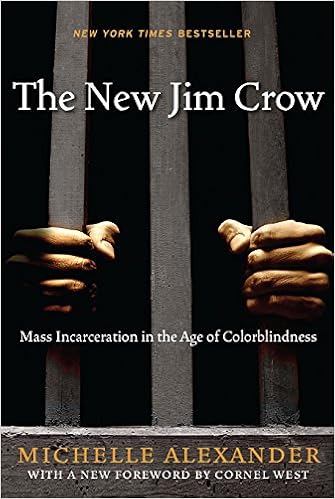
Bail reform is a case in point. Thanks in part to new laws and policies — as well as actions like the mass bailout of inmates in New York City jails that’s underway — the unconscionable practice of cash bail is finally coming to an end. In August, California became the first state to decide to get rid of its cash bail system; last year, New Jersey virtually eliminated the use of money bonds.
But what’s taking the place of cash bail may prove even worse in the long run. In California, a presumption of detention will effectively replace eligibility for immediate release when the new law takes effect in October 2019. And increasingly, computer algorithms are helping to determine who should be caged and who should be set “free.” Freedom — even when it’s granted, it turns out — isn’t really free…
Some insist that e-carceration is “a step in the right direction.” But where are we going with this? A growing number of scholars and activists predict that “e-gentrification” is where we’re headed as entire communities become trapped in digital prisons that keep them locked out of neighborhoods where jobs and opportunity can be found.
If that scenario sounds far-fetched, keep in mind that mass incarceration itself was unimaginable just 40 years ago and that it was born partly out of well-intentioned reforms — chief among them mandatory sentencing laws that liberal proponents predicted would reduce racial disparities in sentencing. While those laws may have looked good on paper, they were passed within a political climate that was overwhelmingly hostile and punitive toward poor people and people of color, resulting in a prison-building boom, an increase in racial and class disparities in sentencing, and a quintupling of the incarcerated population…
If our goal is not a better system of mass criminalization, but instead the creation of safe, caring, thriving communities, then we ought to be heavily investing in quality schools, job creation, drug treatment and mental health care in the least advantaged communities rather than pouring billions into their high-tech management and control. Fifty years ago, the Rev. Dr. Martin Luther King Jr. warned that “when machines and computers, profit motives and property rights are considered more important than people, the giant triplets of racism, extreme materialism and militarism are incapable of being conquered.” We failed to heed his warning back then. Will we make a different choice today? www.nytimes.com/2018/11/08/opinion/sunday/criminal-justice-reforms-race-technology.html?action=click&module=Opinion&pgtype=Homepage

Sarah Sanders criticized for sharing ‘doctored’ video of CNN’s Jim Acosta at press conference
The intern's reach for the mic is slowed down, and the "chop" motion is accelerated. Here's an annotated side by side comparison: pic.twitter.com/wLCG5GVdo1
— Aymann Ismail (@aymanndotcom) November 8, 2018
Further analysis: video is absolutely doctored. You can see the edit when the clips are side by side and slowed down to quarter speed. See for yourself: pic.twitter.com/4ZZrzhislg
— Aymann Ismail (@aymanndotcom) November 8, 2018
www.facebook.com/ATLBlackStar/videos/277771926185419/?t=109
The Little Red Schoolhouse
The Learning Curve: School Bond Bonanza

School bond funds helped pay for a new media studio at San Diego High School. / Photo by Jamie Scott Lytle
School bonds, it turns out, are popular. San Diego County voters passed 10 of 11 construction bonds on this year’s ballot. And, it should be no surprise. Since 2008, roughly 80 percent of all school bond measures in San Diego County have been approved by voters.

But these results point to what, for my money, has turned out to be a major flaw in California’s election law. Even though 11 school districts placed construction bonds on this year’s ballot, not a single district asked voters to approve a parcel tax – which would allow a district to pay for more teachers or, say, expand pre-kindergarten or after-school care.
…on Monday, I published an investigation into the companies that donate to school bond campaigns and the contracts they win. The results were similar to a previous Voice of San Diego investigation: Most major donors to school bond campaigns later win lucrative contracts. It’s a common misconception that school building contracts always go to the lowest bidder. (A misconception spread in part because the chairman of the school bond campaign has said definitively that they go to the lowest bidder.) My investigation found building companies that donated to San Diego Unified school bond campaigns won a combined $320 million in contracts. And the clear majority of those contracts were awarded based on a subjective scoring process; in other words, they didn’t just go to the lowest bidder. All 10 companies that gave more than $10,000 over the past seven years also won contracts. Shout out to Kayla Jimenez who helped with that.
Next, Ry Rivard and I dug into San Diego Unified’s campaign to convince voters on this year’s bond. The district’s main selling point: Get lead out of school water. One commercial featured the 2018 elementary school teacher of the year telling voters, “I buy bottled water for my students so they don’t have to drink school water with lead.” The clear implication was for parents to be afraid. In its 2012 bond campaign, San Diego Unified frightened voters with concerns over asbestos. But after that bond passed, school officials said, actually, much of the asbestos was safe because it wasn’t airborne and didn’t really need to be removed after all.
Finally, I wrote about Sweetwater Union High School District’s credit being downgraded. That’s not exactly a bond story. But it kind of is, because a district’s credit rating speaks to its ability to manage money. Fitch downgraded Sweetwater’s credit rating just days before voters were being asked to pass a $403 million bond. In the end, they passed it with a whopping 65 percent. www.voiceofsandiego.org/topics/education/the-learning-curve-school-bond-bonanza/
www.facebook.com/splinternews/videos/2121219994830111/?t=89
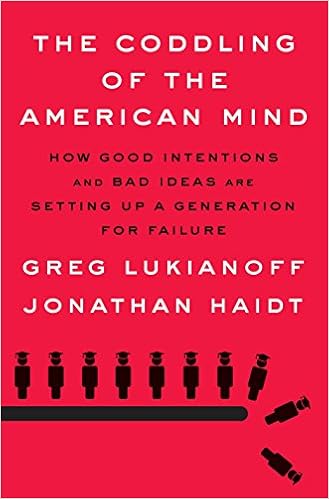
Cspan video discussion link on Coddling of American Mind below:
www.c-span.org/video/?c4750673/coddling-american-mind-haidt
The International Hot War of the Rich on the Poor

US ‘war on terror’ has killed over half a million people: study (good video within)
Between 480,000-507,000 people were killed in Afghanistan, Pakistan and Iraq in the wake of 9/11 attacks, study says.
Hundreds of thousands of people in Afghanistan, Iraq and Pakistan have been killed due to the so-called “war on terror” launched by the United States in the wake of the September 11, 2001 attack, according to a new study.
The report, which was published on Saturday by the Brown University’s Watson Institute for International and Public Affairs, put the death toll between 480,000 and 507,000.
The toll includes civilians, armed fighters, local police and security forces, as well as US and allied troops.
The report states that between 182,272 and 204,575 civilians have been killed in Iraq; 38,480 in Afghanistan; and 23,372 in Pakistan. Nearly 7,000 US troops were killed in Iraq and Afghanistan in the same period.
The paper, however, acknowledged that the number of people killed is an “undercount” due to limitations in reporting and “great uncertainty in any count of killing in war”.
“We may never know the total direct death toll in these wars,” wrote Nera Crawford, the author of the report titled “Human Cost of the Post-9/11 Wars: Lethality and the Need for Transparency”.
“For example, tens of thousands of civilians may have died in retaking Mosul and other cities from ISIS [also known as ISIL] but their bodies have likely not been recovered.
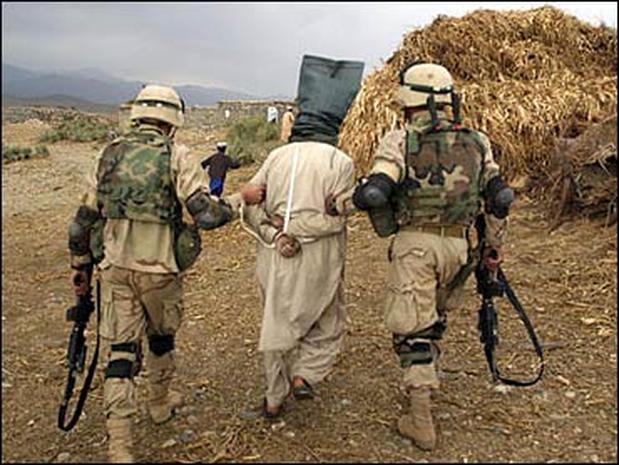
Libya Human Rights Report on Civilian Casualties – July 2018

Tunis, 1 August 2018 – From 1 July to 31 July 2018, the United Nations Support Mission in Libya (UNSMIL) documented 8 civilian casualties –three deaths and five injuries – during the conduct of hostilities across Libya. The casualty toll is the lowest on record since the beginning of the year. Victims included one man, one woman and one boy killed, and four men and one boy injured.
The majority of civilian casualties were caused by gunfire (two killed and five injured), followed by explosive remnants of war (ERW, one killed).
UNSMIL documented civilian casualties in Tripoli (two killed and five injured) and Benghazi (one killed).
UNSMIL documented 20 additional casualties from other possible violations of international humanitarian law and violations or abuses of international human rights law in Benghazi, Sabha, Tazerbu, Zliten and Zuwara.
Civilian Casualty Incidents
On 11 July, a pregnant woman was killed and her one-year-old boy injured at their Tripoli home during the exchange of fire between members of the Special Deterrence Force (SDF) armed group and the victim’s husband, who was reportedly resisting arrest. The spokesperson of the SDF was quoted in the media acknowledging that the woman had been killed by mistake.
ERWs and other unknown explosives continued to claim civilian lives in Benghazi neighbourhoods that had witnessed protracted fighting. On 14 July, a 16-year-old boy was killed when an ERW detonated in the al-Zeriri’iya neighbourhood of Benghazi. reliefweb.int/report/libya/libya-human-rights-report-civilian-casualties-july-2018
www.facebook.com/MarineCorpsTimes/videos/324980538319628/?t=25
Two-star general, Green Berets punished for deadly Niger ambush that killed 4 US soldiers
The military has reportedly punished six troops, including an Air Force two-star general, for their roles in the October 2017 Niger ambush that resulted in the deaths of four American and four Nigerien soldiers, The New York Times reported Saturday.
The punished troops include Air Force Maj. Gen. Marcus Hicks, who was the commander of all special operations troops in Africa, and two members of the 11-man Army Green Beret team that was ambushed. Three others in the team’s chain of command also were reprimanded, according to the Times’ report.
Those punished reportedly include Capt. Mike Perozeni, the Green Beret team leader, and his second in command, a master sergeant. Those two faced reprimands over their planning and team training prior to the mission.
The Times reported that a letter of reprimand given to Perozeni cited the team’s insufficient training and a lack of mission rehearsals. The two senior officers who approved the mission and oversaw the ill-fated operation were not reprimanded, according to the Times, while Hicks was reprimanded for not having appropriate oversight of the officers below him.
A 6,300-page investigation detailed by the Pentagon in May said that the mistakes leading up to the ambush were widespread. An unclassified eight-page summary was released for public viewing. www.armytimes.com/news/your-army/2018/11/05/two-star-general-green-berets-punished-for-deadly-niger-ambush-that-killed-4-us-soldiers/
www.facebook.com/MarineCorpsTimes/videos/707998546224669/?t=10
Tomgram: James Carroll, Entering the Second Nuclear Age?
“They Will Not Forgive Us”
Donald Trump Welcomes in the Age of “Usable” Nuclear Weapons
By James CarrollIt was only an announcement, but think of it as the beginning of a journey into hell. Last week, President Donald Trump made public his decision to abrogate the Intermediate-Range Nuclear Forces Treaty (INF), a 1987 agreement with the Soviet Union. National Security Advisor John Bolton, a Cold Warrior in a post-Cold War world, promptly flaunted that announcement on a trip to Vladimir Putin’s Moscow. To grasp the import of that decision, however, quite another kind of voyage is necessary, a trip down memory lane.
That 1987 pact between Moscow and Washington was no small thing in a world that, during the Cuban Missile Crisis only 25 years earlier, had reached the edge of nuclear Armageddon. The INF Treaty led to the elimination of thousands of nuclear weapons, but its significance went far beyond that. As a start, it closed the books on the nightmare of a Europe caught between the world-ending strategies of the two superpowers, since most of those “intermediate-range” missiles were targeting that very continent. No wonder, last week, a European Union spokesperson, responding to Trump, fervently defended the treaty as a permanent “pillar” of international order.
To take that trip back three decades in time and remember how the INF came about should be an instant reminder of just how President Trump is playing havoc with something essential to human survival.
In October 1986 in Reykjavik, Iceland, the leaders of the United States and the Soviet Union, Ronald Reagan and Mikhail Gorbachev, briefly came close to fully freeing the planet from the horrifying prospect of nuclear annihilation. In his second inaugural address, a year and a half earlier, President Reagan had wishfully called for “the total elimination” of nuclear weapons. At that Reykjavik summit, Gorbachev, a pathbreaking Soviet leader, promptly took the president up on that dream, proposing — to the dismay of the aides of both leaders — a total nuclear disarmament pact that would take effect in the year 2000.
Reagan promptly agreed in principle. “Suits me fine,” he said. “That’s always been my goal.” But it didn’t happen. Reagan had another dream, too — of a space-based missile defense system against just such weaponry, the Strategic Defense Initiative (SDI), also dubbed “Star Wars.” He refused to yield on the subject when Gorbachev rejected SDI as the superpower arms race transferred into space. “This meeting is over,” Reagan then said.
Of the failure of Reykjavik, Soviet Foreign Minister Eduard Shevardnadze would then comment: “When future generations read the transcripts of this meeting, they will not forgive us.” At that point, the nuclear arsenals of the U.S. and the USSR had hit a combined 60,000 weapons and were still growing. (Five new American nuclear weapons were being added each day.) A month after Reykjavik, in fact, the U.S. deployed a new B-52-based cruise missile system in violation of the 1979 SALT II Treaty. Hawks in Moscow were pressing for similar escalations. Elites on both sides — weapons manufacturers, intelligence and political establishments, think tanks, military bureaucracies, and pundits — were appalled at what the two leaders had almost agreed to. The national security priesthood, East and West, wanted to maintain what was termed “the stability of the strategic stalemate,” even if such stability, based on ever-expanding arsenals, could not have been less stable.
But a widespread popular longing for relief from four decades of nuclear dread had been growing on both sides of the Iron Curtain www.tomdispatch.com/blog/176491/tomgram%3A_james_carroll%2C_entering_the_second_nuclear_age
The International Economic War of the Rich on the Poor
White House–CEA Report: The Opportunity Costs of Socialism

Coincident with the 200th anniversary of Karl Marx’s birth, socialism is making a comeback in American political discourse. Detailed policy proposals from self-declared socialists are gaining support in Congress and among much of the electorate.
It is unclear, of course, exactly what a typical voter has in mind when he or she thinks of “socialism.” But economists generally agree about how to define socialism, and they have devoted enormous time and resources to studying its costs and benefits. With an eye on this broad body of literature, this report discusses socialism’s historic visions and intents, its economic features, its impact on economic performance, and its relationship with recent policy proposals in the United States.
We find that historical proponents of socialist policies and those in the contemporary United States share some of their visions and intents. www.whitehouse.gov/briefings-statements/cea-report-opportunity-costs-socialism/
What is Socialism? Communism?

Socialism is the result of a revolution.
Socialism in the absence of a revolution is not socialism.
It may be social/bourgeoisie democracy (meaning elites still control the means of production–but more gently), as in Sweden or Venezuela, but socialism means the working class is in power. That is not possible without a revolution.
Absent a revolution that puts the majority, poor and working people, in control of every aspect of government, the appearances of socialism can be easily reversed. For example, the forty hour week, won by mass worker uprisings in the US in the thirties, has been washed away.
Socialism presumes government, the state, continues to exist, a dictatorship, not of the rich, but of the workers and other formerly oppressed people.
This is called the “dictatorship of the proletariat(extended, this means the workers, peasants, soldiers, etc.),” as distinct from the dictatorship of the capitalists.
Socialism uses its government to apply varying methods to socialize, commune-alize, equalize, production and social life.
It is a stage that Marx and Engles believed could lay the basis for greater and greater equality and democracy (democracy in the absence of generalized equality is always counterfeit).
Once general equality is reached, there is theoretically no need for a state, a government, and when the state “withers away,” communism is won.
The dictatorship of the proletariat presumes leadership of a party which typically led the revolution. (more here www.richgibson.com/whatissocialism.htm)
Trump blames fires, erroneously, on California forest management. Firefighters call it a ‘shameful attack’


GM Lansing Grand River Plant Shutdown, Layoffs
We received an anonymous call on the input lines here this morning that the General Motors Grand River Assembly plant in Lansing is extending the end-of-year shut down that begins December 20th from two weeks to four weeks.
And when employees come back on January 14th, only one shift will reportedly be coming back to the job. wmmq.com/gm-lansing-grand-river-plant-shutdown-layoffs/?trackback=fbshare_mobile&fbclid=IwAR3Nlmo2p7wtbpmpcgdQfytvtu4dBiySHpY8AGi_Jk2qodJyq6HoDqyMKsk

USAID, Monsanto and the real reason behind Delhi’s horrific smoke season
Written by Contributor, 20th October 2018, 9 Comments
The Delhi metropolitan area has one of the highest concentrations of population in the world, and suffocating the people of the area on an annual basis should be treated as a crime against humanity, especially when it can be controlled. Arvind Kumar writes on the connection between USAID, Monsanto and Delhi’s annual air pollution spike.
Until a few years ago, when farmers in Punjab burnt the remnants of the rice crops in their fields in preparation for sowing wheat, the smoke from such fires was confined to Punjab.
According to a publication of the Indian Council of Social Science Research(external link) published in 1991, ‘At the end of September and in early October, it becomes difficult to travel in the rural areas of Punjab because the air is thick with the smoke of burning paddy straw.’
Clearly, farmers burnt the straw in late September and early October. However, in recent years, farmers have delayed the burning until late October.
This delay is crucial and responsible for the smoke being carried all the way to Delhi. An analysis of the wind flow patterns (external link) reveals that wind blows into Delhi primarily from the west during the monsoon season, but changes direction in October and starts blowing into Delhi from the north.
The decision to delay the clearing of the fields was not the choice of farmers, but was forced on them by the Punjab government which passed the Punjab Preservation of Subsoil Water Act (external link) in 2009.
According to this law, farmers could no longer sow rice in April, but had to wait until the middle of June. Rice has a 120-day period between germination and harvest, and the restriction on sowing means that the fields would be harvested and cleared only in October by which time the direction of wind would have changed.
Delhi’s problem of being covered by smoke started right after this law was implemented. www.ecologise.in/2018/10/20/the-real-reason-for-delhis-annual-smoke-season/?fbclid=IwAR2ZEaGR8yIFmMCWjX52E6OAa_3rEcgqaPwhsAga18DuGXm9c3S2RX4CdM8
The Emergence of Fascism as a Popular Mass Movement and The War on Reason
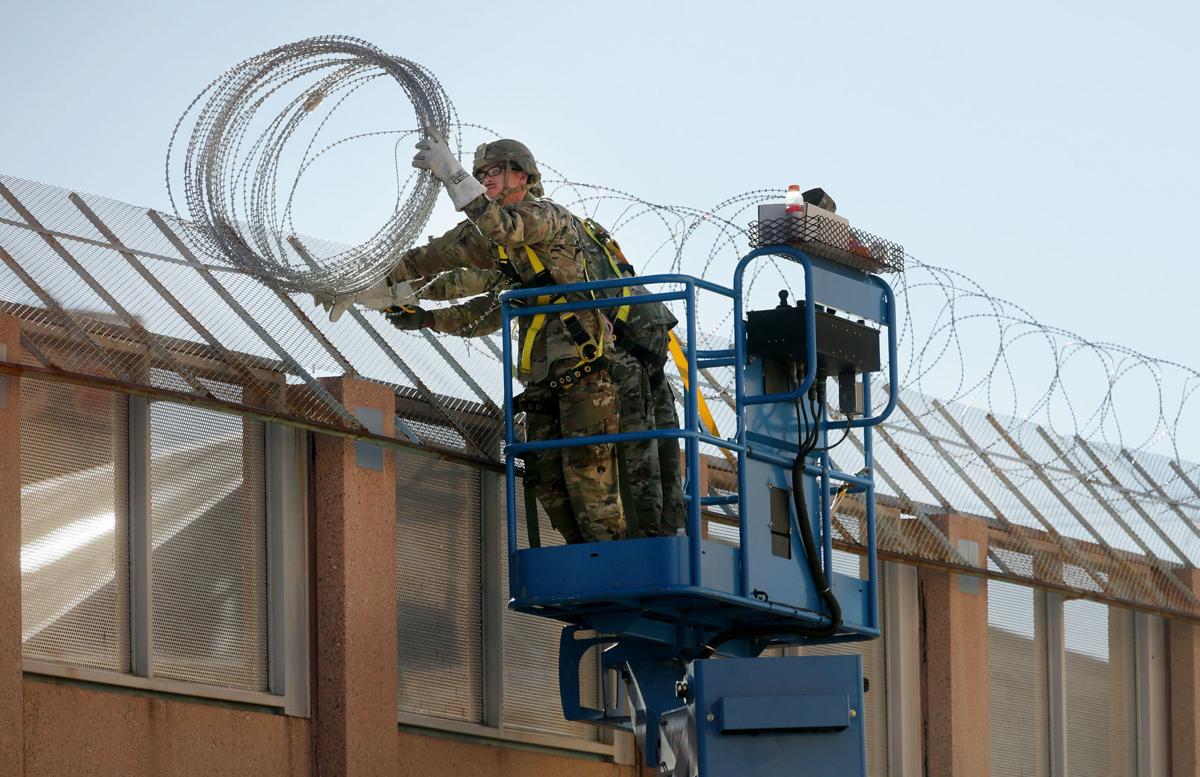
U.S. troops arrive at San Diego border well ahead of migrant caravan
Troops from Camp Pendleton and Texas reported for their first day of work Thursday along the U.S.-Mexico border in San Diego, part of President Trump’s response to thousands of Central American migrants traveling in caravans toward the border.
“We are out here to support Customs and Border Protection to enable them to defend the southern border,” said 2nd Lt. Frederick D. Walker, a Marine spokesman for the military task force assigned to San Diego, as troops nearby unfurled large spools of razor wire and unloaded heavy machinery from vehicles.
Much of the focus, at least initially, will be on strengthening the border barrier.
“We are hardening, if you will, the fence here, putting up concertina wire to make that wall less scalable,” Walker said.
So far, some 1,300 troops have been assigned to support operations along the California-Mexico border. About 1,100 already are serving at Camp Pendleton with the 1st Marine Expeditionary Force as part of a special purpose Marine air-ground task force, officials said Thursday.
They will be deployed in waves as needed, said Michael Kucharek, a spokesman at U.S. Northern Command, which is coordinating the national effort. www.sandiegouniontribune.com/news/california/la-me-border-troops-20181109-story.html
www.youtube.com/watch?v=BfFj2ejhZwc
War Means Work! Report: Military-related spending totals $25B countywide
The combined economic force of the military in San Diego County amounts to more than 330,000 jobs and more than $50 billion spent toward the gross regional product.
The San Diego Military Advisory Council released a report on Thursday containing those numbers as it examined the economic impacts of the military.
“San Diego is home to the largest concentration of military in the world. Its network of Navy, Marine and Coast Guard bases,” the report says, “its intricate supply chain serving major defense contractors and its population of veterans and retirees make it a true ‘super cluster.’”
The military concentration also includes partnerships with research, innovation, health care and secondary spending from tourism, said the report, which showed that more than one in five jobs in the region are supported by defense spending. That spending is likely to increase, as the Department of Defense is focusing more heavily on the Pacific region in response to a rising China — which will affect many in the Navy and the Coast Guard.
Where Marine and Navy personnel work Source: SDMAC DANIEL WHEATON U-T Marine Corps Marine Corps Air Station Miramar 9,161 Marine Corps Recruit Depot, San Diego 1,683 MCRD San Diego (Recruits) 4,375 Camp Pendleton 40,483 Navy Navy hospitals 8,266 Naval Base Coronado 23,256 Naval Base Point Loma 8,876 Other 672 Naval Base San Diego 30,834 $22B
Income generated 22% Of gross regional product Military employment breakdown Breakdown of $25B in direct spending In FY 2017, the total amount of defense spending equated to about $7,600 for each person in San Diego County.
This includes money spent on research through SPAWAR and money spent at military hospitals. Jobs supported by defense spending The jobs include indirect jobs like shipbuilding, education, food services and health care. The military sector outpaces all other military hubs in the country. Active duty 108,100 Civilian 24,100 Reserves 7,600 Retirement and veterans’ benefits 20% Compensation 42% Procurement and other spending 38% Non-defense 78% Defense 22% Total: $25B Total jobs: 338,000

A Look at California Gun Laws, Among the Toughest in the Nation (the empire always comes home).

California, where a gunman killed 12 people in a bar in Thousand Oaks on Wednesday night, has some of the strictest gun laws in the country. It was the first state to ban assault weapons in 1989 after a shooting at a Stockton elementary school left five students dead. In the wake of several recent mass shootings — including one in February in Parkland, Fla., where a gunman killed 17 students and employees at a high school — state legislators put forward at least nine new gun control bills in response. Here’s a look at the state of gun regulations in California:
Recent Legislation
• Raised the age for buying rifles and shotguns from 18 to 21.
• Imposed lifetime bans on gun ownership for those convicted of domestic violence or involuntarily hospitalized for mental illness more than once in a one-year period.
• Strengthened a law prohibiting multiburst trigger devices, including bump stocks.
• Gov. Jerry Brown vetoed two other measures. One would have prohibited the purchase of more than one long gun a month. The other would have allowed teachers and employers to petition the courts to have guns confiscated from people who are a danger to themselves and others.
Previous Regulations
• All firearm and ammunition dealers must obtain a state license. Private gun sales must be completed through a licensed firearms dealer, requiring a background check and mandatory waiting period. The state maintains permanent records of firearm sales.
• In 2016, Governor Brown signed a law expanding the prohibition on assault weapons and regulating the sale of ammunition. With few exceptions, the possession, manufacture, transfer, sale, or lending of assault weapons is prohibited within the state. The state can issue permits for the possession of assault rifles to certain law enforcement agencies or other approved individuals. www.nytimes.com/2018/11/08/us/california-gun-laws.html?action=click&module=Top%20Stories&pgtype=Homepage
Macron stokes anger with plan to honour Nazi collaborator Pétain
French President Emmanuel Macron waded into controversy Wednesday by praising a general who helped win World War I but became a top Nazi collaborator in World War II – comments that triggered outrage among French Jews.
Marshal Philippe Petain’s name appears alongside seven other top military chiefs to be honored this Saturday in a ceremony at the Invalides monument, site of Napoleon’s tomb, to mark the centenary of the end of World War 1.
Touring battlefields ahead of a formal commemoration of the Nov. 11, 1918, armistice that ended the war, Macron said Petain was worthy of the honor for his leading role in the World War I victory.
“Marshal Petain was also a great soldier during World War I” even though he made “fatal choices during the Second World War,” Macron said in the northern town of Charleville-Mezieres. www.france24.com/en/20181108-macron-stokes-anger-with-plan-honour-nazi-collaborator-petain-world-war-1-vichy

My Tijuana makes me happy
In 2008 Tijuana suffered 844 murders. In 2017 it was over 1600.
Those words of the late Rafa Saavedra (2013), one of Tijuana’s favorite writers, struck a chord in me. I am a Tijuana outsider who has been trying and failing to decipher la city since I moved here in 2012. Nothing has been the same since Rafa’s passing. Nothing is ever the same here.
…On October 22, 2017, a month before Border Psycho opened, an armed man, supposedly tied to the cartels, entered El Torito and opened fire. The man injured four women employees of the bar and five men. One of the men died from his injuries later that day. The assailant tried to escape but was detained a mile south in Cañon Johnson. Less than a week after the incident, El Torito opened as if nothing had happened. www.sandiegoreader.com/news/2018/nov/08/feature-tijuana-makes-me-happy/?fbclid=IwAR1CoHvQK0jTJzMvKHHtbpHk3wV-yRk05F8vYJJRQSHTpYX5jIPS3wzHJqc#
Solidarity for Never

Court records: Fear of factory floor fed UAW corruption
The top echelon of the United Auto Workers was so corrupt officials committed crimes out of fear they would lose six-figure jobs, travel perks and expense accounts and be forced to return to the factory floor, according to federal court filings.
Former UAW leaders described a culture of blind obedience during a widespread conspiracy involving the union, Fiat Chrysler Automobiles and the jointly operated UAW-Chrysler National Training Center.
Details of life within the top ranks of the UAW emerged in court filings as three people convicted in the corruption scandal face sentencing Wednesday and as prosecutors signal more people could soon be charged with crimes.
The trio includes Clarkston resident Keith Mickens, 65, the right-hand man of former UAW Vice President General Holiefield. Mickens struck a plea deal with prosecutors in April, admitting he bought more than $7,000 worth of personal items with money from Fiat Chrysler that was supposed to help train blue-collar workers and used more money to help Holiefield buy a pool.
In all, Mickens approved more than $700,000 in illegal payments from Fiat Chrysler to Holiefield and Holiefield’s wife Monica Morgan, part of a broader plan by the automaker to keep labor leaders “fat, dumb and happy,” according to the government.
First ex-UAW official sentenced in FCA-related scandal; gets 1 year

Two figures in the ongoing Fiat Chrysler Automobiles/UAW training center scandal each got a year in prison Wednesday, and a third received a 15-month sentence.
U.S. District Court Judge Paul Borman sentenced Michael Brown, formerly of FCA, and ex-union official Keith Mickens each to one year and one day in prison, ordered $10,000 fines and a year of supervised release after their prison time.
A key former FCA official, controller Jerome Durden, was sentenced later Wednesday morning to 15 months. He will have three years of supervised release and must pay restitution of more than $8,800 to the Internal Revenue Service.
All three will delay reporting to prison for six months so they can continue cooperating with prosecutors.
Mickens was the first former UAW leader sentenced in the case.
Federal prosecutors said FCA and its executives gave millions of dollars to the UAW and union leaders to influence contract bargaining. In contrast, both the company and UAW insist the case was the work of bad actors rather than a reflection of their culture. FCA calls itself “a victim of illegal conduct by certain rogue individuals.”
…Brown gave his testimony even as he was aware his codefendants, including former FCA Vice President Alphons Iacobelli, who received a 5½-year prison sentence, and Durden were using center credit card and bank accounts to conceal payments to former UAW Vice President General Holiefield, who died in 2015, and others, Shaw wrote.
The payments included $30,000 in airline tickets to Holiefield’s widow, Monica Morgan; $200,000 for things like jewelry; and furniture for Holiefield and much more, Shaw said in court, noting that Brown knew the purpose of the conspiracy was to “grease the skids” for contract bargaining.

…Prosecutors were seeking a longer sentence — 16 months — for Mickens, who was once the “third highest official in the UAW’s FCA/Chrysler Department,” but Borman gave him the same sentence as Brown.
Mickens, who had asked not to be sent to prison, contending that he was just following orders, “became ensconced in that culture of corruption where acceptance of lavish entertainment and personal freebies, all paid for by the car company, was the rule rather than the exception,” according to the government.
Mickens, a 65-year-old Cass Tech High School graduate (also Kwame Kilpatrick’s alma mater), admitted in court filings to “making over” invoices and using a training center credit card to buy $7,200 in personal items. Prosecutors have called Mickens Holiefield’s “right-hand man.” They say he “personally approved more than $700,000 in illegal payments from FCA to Holiefield and Holiefield’s wife, codefendant Monica Morgan.”
Borman said in court that Mickens “was a guardian of the UAW’s position. … He violated his obligations to the UAW and FCA.”
Said Mickens, “I done wrong and broke the law, and I’m deeply ashamed of my actions.” He said he had no one to blame but himself.
,,,Two additional former UAW leaders are to be sentenced in coming weeks: Virdell King on Tuesday and Nancy Johnson on Nov. 19.
Prosecutors filed a sentencing memo this week for King, suggesting that the appropriate sentence for the “ground-breaking senior official” who was the first African-American woman elected president of a UAW/Chrysler union local would be a range of 10 to 16 months.
…King, who is a retired UAW associate director, had also named Norwood Jewell, a former UAW vice president and successor to Holiefield, in a court filing, saying he directed her to make improper purchases using a training center credit card. Jewell’s house was searched last year as part of the investigation, but to date, he has not been charged with a crime. www.freep.com/story/money/cars/chrysler/2018/11/07/fiat-chrysler-uaw-scheme/1903606002/

In September, 1970, General Motors was hit by a strike that lasted 67 days. The strike involved more than 400,000 workers or 1 in every 200 workers in the US. The strike, however, was a charade, an effort by the UAW mis-leadership to exhaust its militant membership physically and economically and shove them back to work in order to guarantee the flow of dues income to the UAW bosses. While partial gains were made in the key demands of the strike (30 years of work and out, retirement; and restoration of previously lost cost-of-living adjustments) the UAW did nothing about the grotesque nature of unsafe factory work in the plants. Students from what was left of SDS sought to join the picket lines but were shoved aside by UAW goons.
Pulitzer prize winning reporter William Serrin covered the GM strike, wrote “The Company and the Union, The Inside Story of the Civilized Relationship that has transformed a natural antagonism into a socially destructive partnership and the GM strike of 1970, the most expensive work stoppage in US history.”
At the end of the book, Serrin quotes a UAW member, sold out by the labor tops: “The union and the company, they’re more or less business partners.”
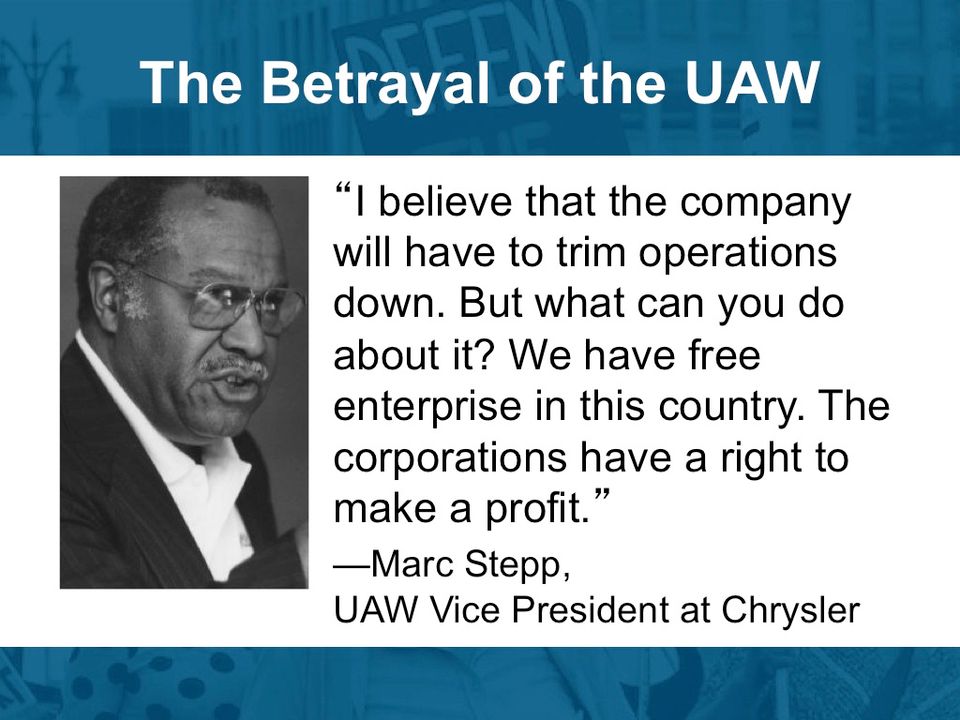
Marc Stepp was a UAW-Chrysler boss, determined to make concessions.

Concessions don’t save jobs. Like giving blood to sharks, bosses just demand more.
Teamsters union says UPS contract deal is approved, even without majority vote
A massive Teamsters labor contract deal for more than 200,000 UPS workers failed to get a majority vote in favor — but the union said the deal has still been ratified because of a provision in its governing principles.
The unusual outcome for the largest collective bargaining agreement in North America presents a predicament for the International Brotherhood of Teamsters and its members at UPS. The company and its shareholders have been hoping approval of the deal — covering UPS drivers, package sorters and loaders, operations and dock workers — would reduce the risk of labor turmoil before the busy holiday shipping season.
The union sent a message to its members reminding them that a “no strike/no lockout clause” remains in effect.
Teamsters leadership has come under pressure from dissident groups of members challenging deals reached by the union.
The Teamsters said out of 209,043 members eligible to vote, only 92,604, or 44.3 percent, cast ballots.
Of those that cast ballots, 54.2 percent voted against the deal. www.myajc.com/business/teamsters-union-says-ups-contract-deal-approved-even-without-majority-vote/KARDb5cdopqUPt5unOTlfI/
Spy versus Spy
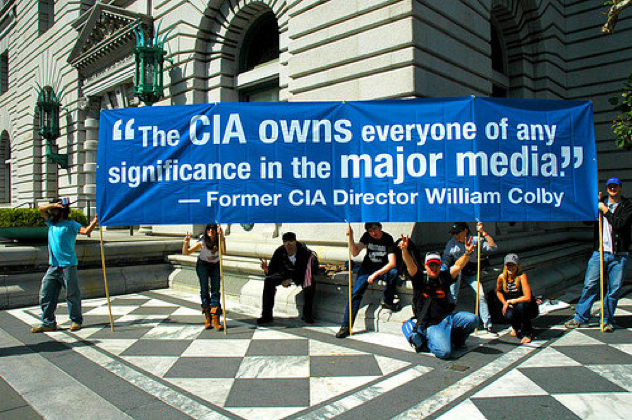
10 Dirty Secret CIA Operations
1: The Mujahadeen

5: Operation Mockingbird
7: Pakistani Vaccine/DNA Collecting Drive

The May 2011 raid that killed Osama Bin Laden (account disputed by Sy Hersh) was the result of an insane amount of intelligence collecting and planning; regardless of his crimes, conducting a US military operation to kill a foreign national on Pakistani soil was bound to have myriad consequences. A courier had been tracked to an Abbottabad compound, where it was pretty damn certain Bin Laden was hiding. But before conducting the raid, they had to be absolutely sure—and one method of collecting this proof was shady in the extreme.
The CIA recruited a respected Pakistani doctor to organize a fake vaccination drive in the town, and in the process collected thousands of blood samples from children in the area children—among them, as it turned out, Bin Laden’s children. Since theirs was a fairly upscale section of town, the campaign began in a poorer area to make it look more authentic, then moved on to the neighborhood housing the Bin Laden compound a month later—without even following up with the required second or third doses in the poor area. The whole thing worked—with consequences.
For one thing, Dr. Shakil Afridi—the doctor involved—has been convicted of treason by the Pakistani government and given a thirty-three-year prison sentence (“Wouldn’t any country detain people for working for a foreign spy service?” one Iranian official helpfully pointed out). For another, the campaign has caused irreparable damage to organizations that carry out legitimate vaccinations. There are deep-seated suspicions in many Middle Eastern regions about those who provide vaccinations, and this gambit to assist in finding Bin Laden has only bolstered those suspicions—particularly in Nigeria, India and of course Pakistan, where efforts to eradicate polio are ongoing.
listverse.com/2013/05/25/10-dirty-secret-cia-operations/
The Magical Mystery Tour
Acting attorney general says judges should have a ‘biblical view of justice’ – archive video
Matthew Whitaker, now acting attorney general after the president fired Jeff Sessions, said of prospective federal judges, ‘are they people of faith? Do they have a biblical view of justice? Which I think is very important.’ Whitaker made the remarks at a conservative forum in April 2014, where he appeared as a candidate for the Republican US Senate nomination in Iowa. www.theguardian.com/global/video/2018/nov/08/acting-attorney-general-says-judges-should-have-a-biblical-view-of-justice-archive-video?CMP=fb_gu&fbclid=IwAR0oVXF0KtqjsReHTvUXul1ukrw-rPc4_2yaOaOOkxPLHqLhZ70TvBGAZtY
50 State AG Call for Grand Jury
Write a letter to the attorney general of your state. Demand, request, and beg them to impanel a grand jury.
Any investigation must be:
- independent of and separate from the church
- must have subpoena powers and ability to compel testimony under oath
Anything short of these criteria is a sham and whitewash.
In addition, write letters to the editor, make phone calls to politicians as they can apply pressure to keep them responsive to our demand. We need to make efforts to ensure that they follow up on what the state is doing to investigate these crimes.
The Attorneys General of forty states have inquired about the grand jury process in Pennsylvania. Let’s get statewide investigations going in fifty states.
Note to Letter Writers
Use your own words and style of writing. Cut and paste from the templates as you wish. Include your experiences, whether as a survivor or as a member of the community. And relate your letter to the state you were abused in or state now living in. www.snapnetwork.org/
Victims: Top US Catholic official should be ousted as President
Cardinal DiNardo’s track record on abuse is “abysmal,” survivor groups say
They also seek help from US ambassador to Vatican
Pope “must make sure bishops keep abuse records”
Victims & advocates file FOIA request for State Dept. & Vatican documents
WHAT
Holding signs and childhood photos at a sidewalk news conference, victims and advocates will call on:
–US bishops to oust their top elected official next week, and
–the US ambassador to the Vatican to help make sure church abuse records aren’t destroyed.
They will also discuss:
–their filing of a Freedom of Information (FOIA) request for all US and Vatican records about clergy sex crimes and cover ups, and
–their request for a meeting with Callista Gingrich, US ambassador to the Vatican. www.snapnetwork.org/usccb_snap_eca_nov18
Officials urge vaccination after 15 measles cases in Michigan
Health officials are urging people to get vaccinated and take other precautions after confirming 15 cases of measles in Michigan this year.
The Michigan Department of Health and Human Services gave an update Friday, saying it’s the highest level the state has seen since 1994 when 26 cases were reported.
“The increases in measles cases being reported drives home the importance of being up-to-date on vaccines,” said Dr. Eden Wells, MDHHS’ chief medical executive. “Immunizations are the best way to protect our families and communities from the harmful, sometimes deadly consequences of vaccine-preventable diseases like measles.”
Earlier this week, the Oakland County Health Division said two Oakland County residents with the disease arrived on a flight at Detroit Metropolitan Airport in Romulus the evening of Oct. 23.
Michigan’s first case of measles in 2018 was also confirmed in a patient who was at Detroit Metro on March 6. Dr. Russell Faust, Oakland County’s medical director, said the county has had three cases of measles this year. www.detroitnews.com/story/news/local/michigan/2018/11/09/michigan-measles-cases-vaccinations-urged/38454093/
The Best and Worst Things in the History of the World
www.facebook.com/YahooNow/videos/251227228845758/?t=58
Cleveland icon ‘The Ghoul’ in hospital after massive heart attack

www.cleveland19.com/2018/11/08/cleveland-icon-ghoul-hospital-after-massive-heart-attack/
Air quality at Bodega Bay California on November 10th


www.facebook.com/NSelection/videos/10154299607351244/?t=47
www.facebook.com/bitser/videos/10156516158138899/?t=0