Rouge Forum Dispatch : Take Note of Richard Haas!
Richard Haas. Chair of the Council on Foreign relations, on Syria and the Middle East: “It’s going to get worse before it gets worse, still. It reminds me of the 30 years war. It is the worst crisis since WWII. It is a toxic mix of religion, politics, and money.” (9/17/05)

We Say Fight Back!
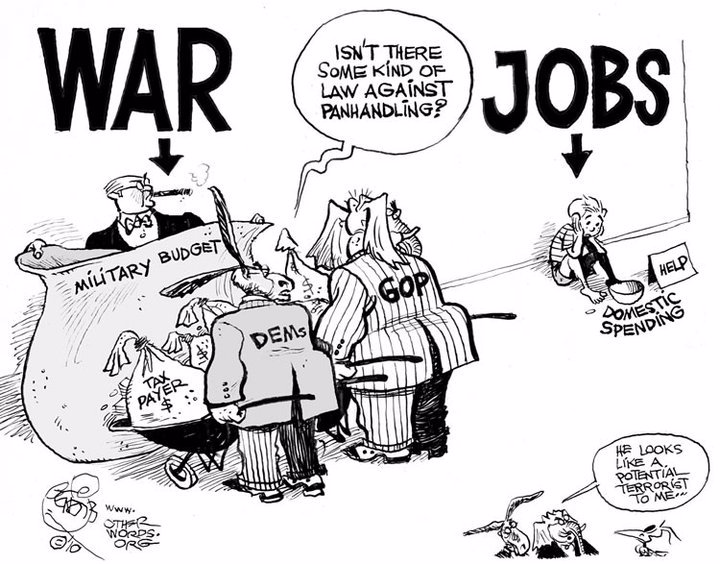
It’s the 50th Anniversary of the
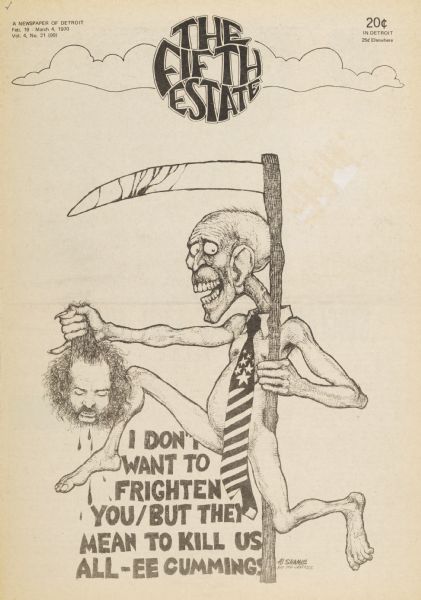
Congratulations on the coming publication of:

What defeats men with guns? Ideas.
The Little Red Schoolhouse

Marcuse on Soviet social-fascist Education (may sound familiar)
To be sure, education is the prerequisite for liberation: only the freedom to learn and to know the whole truth, to grasp the arrested, violated, and destroyed potentialities of man and nature can guide the building of a free society. What kind of education did Stalin envisage? He demanded the introduction of "universal, compulsory, polytechnical education, so that a member of society may be able to make a free choice of occupation and not be shackled for life to any one occupation." ^'^ Following up this program, the Twentieth Congress again places all emphasis on "train- ing" — the training of "specialists on the basis of a close cooperation between studies and production" and calls for "strengthening the ties of the country's scientific establish- ments with production, with the concrete demands of the national economy." ^^The exchangeability of functions, the elimination of the institutionalized division of labor,^^ is indeed in Marxian theoiy the characteristic of a socialist society — as a precondition for the all-sided development of the genuinely human faculties outside the process of material production. But in Stalin's context the Marxian idea appears as that of a society in which all men are tech- nicians and engineers. For Marx and Engels, the goal of communism was the "abolition of labor," ^^ in the Soviet Marxist conception, all will be laborers of the one commu- nist society.^* With the free time transfomied into educa- tion time for polytechnical training, with the work morale anchored in the instinctual structure of man, administra- tive control is secured, and the past is safely transferred into the future. Stalin could thus quote without danger Engels's statement that labor will change from a burden into enjoyment. The enjoyment, however, will not be quali- tatively different from that permitted under repression. The ideological perspective parallels the political per-spective.
The state will continue into the period of com- munism — as will the "capitalist environment." For the state is the "collective subject" of the national economy which organizes the whole of society, and this organization has become the objectified representative of society over and above the individuals. Since societal production is sys- tematically directed by the state and since the basic de- cisions are imposed upon the society by the state, progress itself, that is to say, the use of the growing productivity for the needs and aspirations of the individuals, must pass through the agencies of the state.
The continuity of the
administration thus bridges the gap between necessity and
freedom, and assimilates the first and the second phase,
socialism and communism. And the administration, as we
have tried to show, depends on the ever more effective
growth and utilization of the productivity of labor: it tends
to drive society to a higher stage. Industrialization and
rationalization, carried through according to standards of
competitive efficiency at the national and international
level, and developing human beings as ever better function-
ing instruments of material and intellectual labor, are
likely to bear economic as well as political fruits — over-
ruling the diverging interests and intentions of particular
groups and individuals.

The reward will not be the end of domination of man by
man......https://archive.org/stream/sovietmarxismcri00marc/sovietmarxismcri00marc_djvu.txt
 Number of homeless students in U.S. has doubled since before the recession
The number of homeless children in public schools has doubled since before the recession, reaching a record national total of 1.36 million in the 2013-2014 school year, according to new federal data.
The latest homeless count, an 8 percent increase over the 2012-2013 school year, is a sign that many families continue to struggle financially even as the economy recovers from the housing collapse of 2008. And it offers a glimpse of the growing challenges that public schools face nationwide as they seek to educate an increasing number of low-income children.
The impact is profound on public schools, which struggle to try to address the needs of homeless children. Teachers often find themselves working not only to help children learn but also to clothe them, keep them clean and counsel them through problems — including stress and trauma — that interfere with classroom progress. www.washingtonpost.com/local/education/number-of-us-homeless-students-has-doubled-since-before-the-recession/2015/09/14/0c1fadb6-58c2-11e5-8bb1-b488d231bba2_story.html
Racism and the demographics of school work Over 25 years, from 1987 to 2012, minority teachers have actually grown as a percentage of the teaching workforce, from 12 to 17 percent. However, that modest change is nowhere near keeping pace with student demographics, now that over half of public school students are children of color, leaving the institute to conclude that “More than 60 years after the ruling in Brown v. Board of Education was handed down, its promise remains un-fulfilled.”…
Nationwide, teacher attrition remains an enormous problem, costing schools $2.2 billion per year. Just over half of all new teachers are still in the classroom five years later, NPR reports. Although the financial cost of that “revolving door” is formidable, the real price is paid in student learning, which suffers from losing more experienced teachers year after year…Teachers leave the profession for dozens of reasons, but one common one is the challenging working conditions in the country’s most under-resourced schools, which tend to have a high percentage of both minority students and minority teachers; a 2014 study from the National Education Association found that teachers in low-performing schools were 50 percent more likely to leave the classroom. http://www.csmonitor.com/USA/Education/2015/0917/Why-are-US-teachers-so-white

Dr. Diane Ravitch, Friend of Education Award recipient speaks to delegates during the 2010 NEA Annual Meeting and Representative Assembly.
Vacillating Reactionary Ravitch’s Fave Superintendent, San Diego’s Cindy Marten, illegally fired one of the finest principals in the system on the urging of the wacko School Board President Mitzi Lizarraga, the former principal of the School of Creative and Performing Arts, told me last month that school board president Marne Foster used her influence to meddle in day-to-day operations at her son’s school. Doing so is against board policy. Emails obtained by Voice of San Diego through public records requests show Lizarraga was right.
Foster demanded a copy of a college evaluation written about her son. She requested that a negative evaluation be retracted and replaced with a more positive one. To a senior district official, Foster blamed Lizarraga for the negative evaluation, questioned her leadership abilities, and asked for the email records of individuals she assumed were responsible for the college-reference.
Until now, whether Foster had pressured school or district staff about the issue was a matter of dispute and based on accusations from Lizarraga and others. An earlier Grand Jury report accused Foster of abusing her power to intimidate SCPA staff and meddle in school operations. Foster told Voice of San Diego those allegations were false.
“If you read that report you would think that my son’s counselor wrote a bad report, I was upset, and then heads started rolling. And that’s not at all what happened. At all,” she told me in July.
The emails, however, reveal Foster was furious about her son’s evaluation and demanded action.
Aiding her efforts was Joe Fulcher, the former chief student services officer. Fulcher has since moved to Sweetwater Union High School District. He declined to comment.
Superintendent Cindy Marten was copied on an email Foster sent to Fulcher in Dec. 2013 – just days after the evaluation letter was submitted on behalf of Foster’s son. www.voiceofsandiego.org/topics/education/school-board-president-demanded-action-of-district-staff-after-bad-evaluation-of-son/?utm_source=Voice+of+San+Diego+Master+List&utm_campaign=cf5c6d9b3d-Morning_Report&utm_medium=email&utm_term=0_c2357fd0a3-cf5c6d9b3d-81862829&goal=0_c2357fd0a3-cf5c6d9b3d-81862829
 The Education Agenda is a war agenda: class and empire’s wars, as the test scores below demonstrate, again.

“We do still see there are challenges for our language learners, the economically disadvantaged, and African-American and Hispanic student groups,” said Karla Groth, who oversees assessment and accountability with the county education office. “But I think overall we are pleased at the county’s results, and that we are in a good starting place.”

After 15 and more years, the education agenda remains a war agenda, class and empire’s wars, as the test scores, measuring class, race, and home language, demonstrate.

Investing heavily in school computers and classroom technology does not improve pupils’ performance, says a global study from the OECD.
The think tank says frequent use of computers in schools is more likely to be associated with lower results.
The OECD’s education director Andreas Schleicher says school technology had raised “too many false hopes”.
Tom Bennett, the government’s expert on pupil behaviour, said teachers had been “dazzled” by school computers.
The report from the OECD examines the impact of school technology on international test results, such as the Pisa tests taken in more than 70 countries and tests measuring digital skills.
It says that education systems which have invested heavily in information and communications technology have seen “no noticeable improvement” in Pisa test results for reading, mathematics or science. www.bbc.com/news/business-34174796
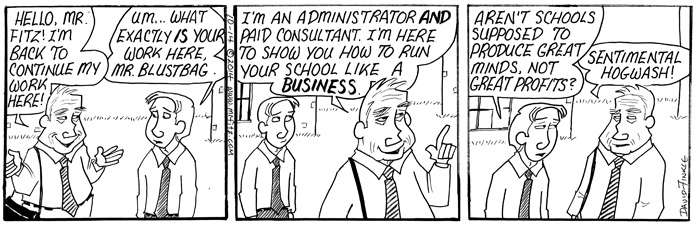
Detroit Public Schools borrows $121.2M as deficit grows Detroit Public Schools’ deficit is growing by millions of dollars as it continues to borrow additional millions.
According to a quarterly report issued Wednesday by the Michigan Department of Education, the state’s largest district projected its deficit at $238.2 million as of June 30, up from $169.4 million a year earlier. The state report says DPS was among 14 districts whose deficits climbed in 2014-15.
Michelle Zdrodowski, a DPS spokeswoman, said factors behind the deficit spike included lower revenue from property taxes and asset sales, higher maintenance and utility costs and a charge for legal contingencies.
Friday, the district borrowed $121.2 million through the Michigan Finance Authority. State aid revenue notes to be issued by the finance authority carry a 5.75 percent interest rate and are due Aug. 22, 2016.

Detroit Federation of Teachers Suicides The former president of the Detroit Federation of Teachers failed to get the two-thirds majority vote needed to overturn his ouster by the union’s executive board at a packed meeting this evening that drew about a thousand current and retired teachers to the Masonic Temple.
An outraged Steve Conn said he plans to form his own teachers union.
Conn won the popular vote — 527 DFT members voted in his favor while 473 voted to uphold the executive board’s decision to kick him out of office — but the numbers ultimately fell short.
“We will not accept this sham!” a red-faced Conn called out as his supporters angrily walked out of the meeting, some pledging to stop paying union dues.
Conn, 57, was stripped of his title and expelled from the union last month after a two-day trial at which he was convicted of five misconduct charges.
“It’s a travesty,” teacher Michele Pittel as she left the meeting. “They lied and they cheated, and they brought false charges against Steve.”
Pittel and other Conn supporters said it was unfair that the executive board, which includes Conn’s opponents, presided over the trial and rendered the guilty verdict. www.freep.com/story/news/local/michigan/detroit/2015/09/17/steve-conn-detroit-teachers-union/32557147/
Hey NEA! 3 Years After your demand for his resignation, Duncan still employed! Where are the pickets?
www.youtube.com/watch?v=kM0vRes91rA
The International Hot War of the Rich on the Poor
Admiral McRaven, former leader of JSOC death squads, now head of the UT’s
Suicides in a Unit under Heavy Measures in Afghanistan Almost seven years after the deployment, suicide is spreading through the old unit like a virus. Of about 1,200 Marines who deployed with the 2/7 in 2008, at least 13 have killed themselves, two while on active duty, the rest after they left the military. The resulting suicide rate for the group is nearly four times the rate for young male veterans as a whole and 14 times that for all Americans.
The deaths started a few months after the Marines returned from the war in Afghanistan. A corporal put on his dress uniform and shot himself in his driveway. A former sergeant shot himself in front of his girlfriend and mother. An ex-sniper who pushed others to seek help for post-traumatic stress disorder shot himself while alone in his apartment.
The problem has grown over time. More men from the battalion killed themselves in 2014 — four — than in any previous year. Veterans of the unit, tightly connected by social media, sometimes learn of the deaths nearly as soon as they happen. In November, a 2/7 veteran of three combat tours posted a photo of his pistol on Snapchat with a note saying, “I miss you all.” Minutes later, he killed himself.
The most recent suicide was in May, when Eduardo Bojorquez, no relation to Manny, overdosed on pills in his car. Men from the battalion converged from all over the country for his funeral in Las Vegas, filing silently past the grave, tossing roses that thumped on the plain metal coffin like drum beats.
“When the suicides started, I felt angry,” Matt Havniear, a onetime lance corporal who carried a rocket launcher in the war, said in a phone interview from Oregon. “The next few, I would just be confused and sad. Then at about the 10th, I started feeling as if it was inevitable — that it is going to get us all and there is nothing we could do to stop it.”
For years leaders at the top levels of the government have acknowledged the high suicide rate among veterans and spent heavily to try to reduce it. But the suicides have continued, and basic questions about who is most at risk and how best to help them are still largely unanswered. The authorities are not even aware of the spike in suicides in the 2/7; suicide experts at the Department of Veterans Affairs said they did not track suicide trends among veterans of specific military units. And the Marine Corps does not track suicides of former service members.
Feeling abandoned, members of the battalion have turned to a survival strategy they learned at war: depending on one another. Doing what the government has not, they have used free software and social media to create a quick-response system that allows them to track, monitor and intervene with some of their most troubled comrades. …
After the eighth suicide in the battalion, in 2013, Mr. Bojorquez decided he needed professional help and made an appointment at the veterans hospital in Phoenix.
He sat down with a therapist, a young woman. After listening for a few minutes, she told him that she knew he was hurting, but that he would just have to get over the deaths of his friends. He should treat it, he recalled her saying, “like a bad breakup with a girl.”
The comment caught him like a hook. Guys he knew had been blown to pieces and burned to death. One came home with shrapnel in his face from a friend’s skull. Now they were killing themselves at an alarming rate. And the therapist wanted him to get over it like a breakup?

‘No thanks for your service’: Veteran says Chicago restaurant kicked him out because he had a service dog a french restaurant in Chicago was forced to apologize Saturday after a a military veteran said an employee refused to serve him because he was accompanied by his service dog.
The restaurant, Cochon Volant, received a slew of angry messages on social media from people angry about the incident Saturday morning. The veteran in question appears to be Diggs Brown, who wrote on Facebook:
“September 12. Veteran and service dog refused service and asked to leave the Cochon Volant Restaurant in Chicago. We were seated, ordered breakfast, and then the manager, Hanna, came over and told us I would not be served due to having a dog. I explained that Arthur was a service dog and the Americans With Disabilities Act (ADA) allows service dogs anywhere and she would be violating the law. ‘I don’t care’ was her response. We left without causing a scene. Guess this would be a case of ‘No thanks for your service.’” www.rawstory.com/2015/09/no-thanks-for-your-service-veteran-says-chicago-restaurant-kicked-him-out-because-he-had-a-service-dog/
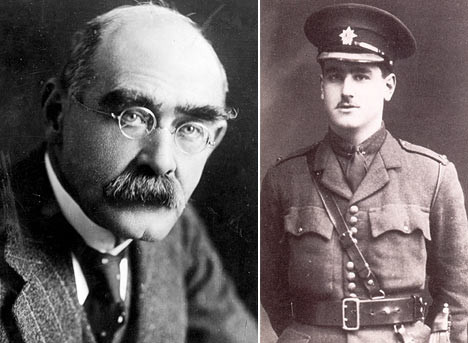 Rudyard Kipling and his son, killed in WWI
From his poem, “Tommy”
We aren't no thin red 'eroes, nor we aren't no blackguards too,
But single men in barricks, most remarkable like you;
An' if sometimes our conduck isn't all your fancy paints,
Why, single men in barricks don't grow into plaster saints;
    While it's Tommy this, an' Tommy that, an' "Tommy, fall be'ind",
    But it's "Please to walk in front, sir", when there's trouble in the wind,
    There's trouble in the wind, my boys, there's trouble in the wind,
    O it's "Please to walk in front, sir", when there's trouble in the wind.

You talk o' better food for us, an' schools, an' fires, an' all:
We'll wait for extry rations if you treat us rational.
Don't mess about the cook-room slops, but prove it to our face
The Widow's Uniform is not the soldier-man's disgrace.
    For it's Tommy this, an' Tommy that, an' "Chuck him out, the brute!"
    But it's "Saviour of 'is country" when the guns begin to shoot;
    An' it's Tommy this, an' Tommy that, an' anything you please;
    An' Tommy ain't a bloomin' fool -- you bet that Tommy sees!   http://www.poetryloverspage.com/poets/kipling/tommy.html

General admits only “four or five” US-trained fighters remain on battlefield after Division 30 was sent into Aleppo.
Only a handful of the estimated 60 deployed US-trained Syrian fighters are still engaged in the campaign, which is substantially short of the US goal to train and equip 5,400 a year at a cost of $500m.
Lloyd Austin, a top US general who oversees the war effort in Syria, told the Senate Armed Services Committee on Wednesday that “four or five” US-trained fighters remained on the battlefield.
Austin’s admission came as defence officials scrambled separately to respond to allegations that they skewed intelligence assessments to exaggerate the progress made against ISIL.www.aljazeera.com/news/2015/09/pentagon-criticised-failing-arm-syria-rebels-150917051822249.html?utm_source=feedburner&utm_medium=feed&utm_campaign=Feed%3A+mycenews+%28MyCen+News%29
The International Economic War of the Rich on the Poor

GM Murdered at least 169 people, wrist slapped, no prosecutions of bosses (and they will pay the fine with public bailout money) General Motors agreed to pay $900 million to fend off criminal prosecution over the deadly ignition-switch scandal, striking a deal that brought criticism down on the Justice Department for not bringing charges against individual employees.
The switches, which can slip out of the “run” position and cut off the engine, have been linked to at least 169 deaths.
Despite evidence that GM’s legal and engineering staffs concealed the problem for nearly a decade, no employees were charged Thursday, though U.S. Attorney Preet Bharara said the investigation is still going on.
Also Thursday, GM announced it will spend $575 million to settle the majority of the civil lawsuits filed over the scandal.
Under the deal with prosecutors, an independent monitor will be appointed to oversee GM’s handling of safety problems. Two charges drawn up against GM — wire fraud and scheming to conceal information from government regulators — will be dropped after three years if the automaker cooperates fully.
GM agreed to a statement of facts that describes in scathing terms its deceptive and dismissive approach to the defect.
“They let the public down,” Bharara said. “They didn’t tell the truth in the best way that they should have — to the regulators, to the public — about this serious safety issue that risked life and limb.”
The twin agreements bring to more than $5.3 billion the amount GM has spent on a problem authorities say could have been handled for less than a dollar per car. Those expenses include fines, compensation for victims and the recall of millions of vehicles. www.nytimes.com/aponline/2015/09/17/us/ap-us-general-motors-criminal-probe.html?_r=0

17,000 Migrants Stranded in Croatia by Border Crackdown As key nations tighten their borders, thousands of migrants and asylum seekers hoping to enter Western Europe are now bottled up in the Balkans, placing precarious new burdens on a region of lingering sectarian divisions that is exceptionally ill prepared to handle the crisis that has been shunted to it.
More than 17,000 migrants have entered Croatia since Wednesday, and were essentially trapped there, having been blocked from Hungary, sent packing from Serbia and unable to move on to Slovenia. The migrants have become a sloshing tide of humanity, left to flow wherever the region’s conflicting and constantly changing border controls channel them.
Along the roads of eastern Croatia on Friday, the migrants’ detritus — abandoned blankets, torn clothing, empty cans of tuna — littered the highways. On the side of a road outside the border town of Tovarnik, Croatia, three young Iraqi men said they had been stranded for two excruciating days.
“It was crowded, there was no food, no transport and nowhere to go,” said one of them, Ibrahim Yusuf, 25, a construction worker from Baghdad. He said he was considering returning to Iraq and asked a reporter for directions back to Belgrade, the capital of Serbia.
Even while the surge of migrants was merely transiting the region, starting several weeks ago, it overwhelmed tiny Macedonia, which declared a state of emergency. Now, however, it has become clearer that the migrants face fast-rising barriers to passing through the Balkans en route to preferred destinations like Germany or Sweden.
The shifting of the crisis to the Balkans has added a whole new dynamic to the crisis, threatening to reopen old wounds and distrust. The masses of migrants and refugees are struggling through the clutch of countries that once formed Yugoslavia, until the wars of the 1990s bloodily broke the former Communist state apart.
As hundreds of refugees continued to stream into Croatia on Friday, the government announced that it would close its borders with Serbia. Prime Minister Zoran Milanovic said his country was overwhelmed, and Interior Minister Ranko Ostojic had a message for the migrants: “Don’t come here anymore. This is not the road to Europe.”http://www.nytimes.com/2015/09/19/world/europe/refugee-migrant-crisis-europe.html?hp&action=click&pgtype=Homepage&module=second-column-region®ion=top-news&WT.nav=top-news&_r=0

Ferguson discovers….racism! A commission appointed by Missouri Gov. Jay Nixon in the aftermath of last year’s unrest in Ferguson, Mo., is calling for a series of sweeping steps to attack the issue of racial inequity in the St. Louis region.
The nearly 200-page report released Monday lays out 47 priorities for the region to tackle and dozens of policy recommendations. Among the recommendations made by the commission are establishing a publicly available statewide use-of-force database to track police shootings, consolidating the St. Louis area’s many police departments and municipal courts and increasing the region’s minimum wage.
The Ferguson commission was established by Nixon in November as anger and protests grew in the months after Michael Brown, 18, was fatally shot by white police officer Darren Wilson. A St. Louis County grand jury declined to indict Wilson and the Justice Department closed its investigation without filing criminal charges against the officer.
But the incident, which garnered international attention, put the focus on the long festering problem of racial inequity in St. Louis, where black residents have complained they have been disproportionately targeted by police and municipalities looking to raise revenue to keep their cities afloat. www.usatoday.com/story/news/2015/09/14/ferguson-commission-releases-recommendations-racial-inequity/72248102/
 Kerner Commission Report, 1968 historymatters.gmu.edu/d/6545/
The Decline in Labor’s Share of Corporate Income Since 2000 Means $535 Billion Less for Workers
Between 2000 and the second quarter of 2015, the share of income generated by corporations that went to workers’ wages (instead of going to capital incomes like profits) declined from 82.3 percent to 75.5 percent, as the figure shows. This 6.8 percentage-point decline in labor’s share of corporate income might not seem like a lot, but if labor’s share had not fallen this much, employees in the corporate sector would have $535 billion more in their paychecks today. If this amount was spread over the entire labor force (not just corporate sector employees) this would translate into a $3,770 raise for each worker.
As Lawrence Mishel and I discuss in our recent paper, the largest wedge driving the growing gap between economy-wide productivity and typical workers’ pay is rising inequality. Part of this increase in inequality is the shift in national income from labor compensation to capital incomes. Since 2000, this decline in labor’s share of income has become a significant contributor to the inequality wedge. The figure shows labor’s share of corporate sector income. Because all income in the corporate sector is either classified as labor compensation or capital incomes (profits plus net interest), this makes it a sensible first place to look for this labor-to-capital shift. (Chart at link: www.epi.org/publication/the-decline-in-labors-share-of-corporate-income-since-2000-means-535-billion-less-for-workers/?utm_source=Economic+Policy+Institute&utm_campaign=15b8eadab9-EPI_News_09_11_159_11_2015&utm_medium=email&utm_term=0_e7c5826c50-15b8eadab9-58180353)
The Clinton Money Connections Bill and Hillary Clinton were barely out of kindergarten in 1953 when Clyde McPhatter and the Drifters recorded what could be the former first couple’s theme song, “Money Honey,” with the refrain, “You gotta have money, honey, if you want to get along with me.”
Money is clearly honey to the Clintons, and they have been busy as bees collecting it in speech income and gifts to the Bill, Hillary and Chelsea Foundation. To put some numbers on it:
Since 2001, according to The New York Times, the Clintons have earned $125 million in speaking fees. The Washington Post says the Clinton Foundation has raised “close to $2 billion from a vast global network that includes corporate titans, political donors, foreign governments, and other wealthy interests,” including $262 million in 2013 alone, the year after Hillary stepped down as Secretary of State and began running for president. That money seems to be piling up. Between 2008 and 2013 the foundation gave away less than $90 million of the more than $640 million it collected.
During most of this time, Bill Clinton has been the chief breadwinner for the family and the foundation because Mrs. Clinton was in public office as a senator and Secretary of State until the end of 2012. But Hillary began giving speeches for pay in 2014, and the family’s combined speech income for 2014 and the first four months of 2015 was $25 million. Not bad.
That’s on top of Bill Clinton’s federal pension and office allowance of nearly $1 million a year, and the millions earned by Hillary’s books. www.newcriterion.com/posts.cfm/Hillarious-7770
The Emergence of Fascism as a Popular Mass Movement
And in Detroit–
Solidarity for Never

Mike Antonucci: What the Hell Just Happened in Seattle?
Posted: 16 Sep 2015 09:16 AM PDT
The representative bodies of the Seattle Education Association voted to suspend its strike, pending a Sunday ratification vote by the full membership on a tentative agreement reached yesterday.
The union is touting a 30-minute guaranteed student recess (it originally wanted 45 minutes) and the fact that teachers will no longer be evaluated in any way on student test scores. These were important issues for the union, but the teachers didn’t go on strike for recess. What about the money?
The district’s final salary proposal before the strike was 2% the first year, 3.2% the second year, and 3.75% the third year, plus an additional 0.25% for an additional 20 minutes of instruction time (not a longer day, but a reapportionment of time). Telling members the district’s offer “falls short,” the union countered with 7%-7%-7% for the three years.
On September 14, the district’s pay offer was the same. SEA said this “wasn’t good enough” and countered with a 4.75%-5% two-year deal.
The final result? 3% the first year, 2% the second year and 4.5% the third year with (apparently) pro rata pay for 20 additional minutes of instruction.
“Let’s be clear,” said SEA bargaining chair Phyllis Campano. “We won the fight on this contract agreement.”
If we look at our hypothetical beginning Seattle teacher, currently making $246.51 each work day, the district’s pre-strike proposal would have raised her pay to $259.49 by the second year. Under the tentative agreement, she will be making $258.99 – 50 cents a day less.
The third year pushes that to $270.64, or 77 cents a day more than the district was offering. That’s $138.60 a year won over the course of a five-day strike. And that’s not realized until the 2017-18 school year.
As I mentioned in Monday’s communiqué, for almost any other union besides a teachers’ union, this would have been a huge money loss for the members. A five-day strike would have cost our beginning teacher more than $1,232 in lost pay, so this deal would have meant an almost $1,100 net loss. Of course, schools have the requirement and the open calendar to make up lost days, and the district has already announced its plan.
The first three days of the strike will be made up using the built-in snow make-up days as previously negotiated with SEA: one mid-year snow day and two days at the end of the school year. All additional make-up days will need to be determined at a later date in discussion with SEA. Typical options are shortening mid-year vacations, using Saturdays or changing the end of the school year.
Let’s hope there isn’t much snow in Seattle this winter.
The majority of comments on SEA’s Facebook page are negative, but that shouldn’t be seen as any indication of how Sunday’s vote will turn out. I do expect, however, that pay will dominate the debate between now and then.
Read the Seattle EA’s Facebook page on the sellout led by the ISO’s and TFA’s Hagopian, the DSA’s Rethinking Schools (“we will teach our way out of capitalism) and the other fake socialists who sold out SEA’s strike www.facebook.com/SeattleEA?v=wall&viewas=0
On the failed Trot Hagopian www.pugetsoundsocialists.org/tag/jesse-hagopian/
Reminder about the rewards for the Junior Partners of Capital + empire
Nea’s former bosses past gross pay


With the UAW Contract Expiring (and sellout certain) Members can now quit the union, reject dues, but here’s what the dues-eaters at the top of MEA sought to do to lock down dues returns
When Michigan became the 24th right-to-work state late last year, everyone knew unions would try to overturn or otherwise neuter the law. Less expected was that they would do so at the expense of their own members.
That’s the message from a December 27-28 memo to local union presidents and board members from Michigan Education Association President Steven Cook, which recommends tactics that unions can use to dilute the impact of the right-to-work law. One bright idea is to renegotiate contracts now to lock teachers into paying union dues after the right-to-work law goes into effect in March. Another is to sue their own members who try to leave.
“Members who indicate they wish to resign membership in March, or whenever, will be told they can only do so in August,” Mr. Cook writes in the three-page memo obtained by the West Michigan Policy Forum. “We will use any legal means at our disposal to collect the dues owed under signed membership forms from any members who withhold dues prior to terminating their membership in August for the following fiscal year.” Got that, comrade?
Also watch for contract negotiations in which union reps sign up members for smaller pay raises and benefits in exchange for a long-term contract. “We’ve looked carefully at this and believe the impact of RTW [right to work] can be blunted through bargaining strategies,” Mr. Cook writes.
The union filed its inevitable lawsuit against the law last week. But in his memo, Mr. Cook admits this is a long shot, as is a challenge based on technicalities like the law’s carve-out for police and fire fighters. “Because of wording contained in the Act,” Mr. Cook writes, “challenging the carve out might not strike down the Act but could merely put police and fire into the same RTW pit the rest of us are in.”
Unions may have learned from last year’s meltdown in Wisconsin over Governor Scott Walker’s reforms. While Big Labor waged an unrelenting campaign to overturn the law in court and to recall Mr. Walker and Wisconsin legislators, there has been little serious discussion of a similar effort against Governor Rick Snyder in Michigan. “If the goal is to undo RTW, this is the least appealing of the options,” Mr. Cook writes of potential recalls.
The pattern in new right-to-work states is that union membership plunges when it is voluntary. That’s what happened in Wisconsin and Indiana, and it will probably happen in Michigan too.
Yet the most revealing news in the Cook memo is how little the union discusses assisting workers so more will voluntarily join unions. Instead the focus is how to continue coercing workers to keep paying dues. No wonder that the percentage of government workers who belong to unions fell last year. The Cook memo is damning proof that the main goal of union leaders is to enhance the power of union leaders, not of workers. www.wsj.com/articles/SB10001424127887323701904578275873768466336
 Comments About the UAW Sellout at Fiat Chrysler I would LOVE to see my husband get a raise, although I doubt he’s included. He’s worked for Chrysler (and all of it’s other names) and the UAW for 26 years, and he hasn’t had a raise in 14 years! That’s right, 14. He’s never gotten the ratification bonus, profit sharing, never even got a pen for his 20 or 25 year work anniversary. He needs some good news because he’s feeling disenfranchised.
This Contract is INSULT TO RETIREES,yes we are out of workforce. In 2007 , Gettlefinger & Obama where quick enougn to take the $700 Christmas Bonus ,something we had paid for while working.
We have to pay for Medical Ins., I now pay $111.50/MO =$1338 /yr for a lesser Ins than I was given when I Retired . When I Retired I paid for nothing ,BECAUSE WHEN MY NEGOTIATED WAGES WERE DEFFERED FOR PAID INSURANCE FOR RETIREES !! I am asking for what is owed me ,others may have forgot ,but I always took the negotiations seriously .
I have always been a Democrat so I am not one of these Birthers will an agenda,Obama did say he was a Union man would repay the benefits after the bankruptcy ,well, I know what reality is,but it is up to the President ant FCA & the UAW ,VOTE THE CONTRACT DOWN ,IT IS TIME FOR PAY BACK
Why ask to vote on it if all they have to do is veto it, and let it pass anyways,what are they going to do when the gas goes back up and nobody wants a truck or suv anymore,I think we as members should take the uaw back www.detroitnews.com/story/business/autos/chrysler/2015/09/18/fca-uaw-highlighter/72408372/
Tiny NEA New Hampshire endorses Hillbillary The National Education Association-NH has announced its endorsement of Democrat Hillary Clinton, who returns Thursday for three days of campaigning.
NEA-NH has about 16,000 members. In the announcement, Scott McGilvray, NEA-NH president, calls Clinton a “tireless fighter” for students and teachers.
College affordability is one of the issues Clinton will talk about later this week. Clinton’s schedule includes a “conversation on substance abuse” in Nashua on Thursday, followed by a forum at the Boys and Girls Club of Laconia Thursday afternoon.
On Friday, Clinton has a forum on college affordability at the Memorial Union Building at the University of New Hampshire in Durham at 11 a.m. and a dinner with Plymouth area Democrats at the Common Man in Plymouth at 7 p.m. – See more at: www.unionleader.com/article/20150914/NEWS0605/150919604&source=RSS#sthash.k2NDxDa9.dpuf
Spy versus Spy
In the latest twist to the saga of Sgt. Bowe Bergdahl, his military attorney quietly reached out to the same former CIA officer who earlier this year told Fox News Bergdahl was stoned after he walked off his Afghanistan post in 2009 –but this time in an effort to help Bergdahl’s case.
Not only that, the lawyer had tried to discredit the same source in a public filing.
According to military documents, Bergdahl’s defense team took aim at former CIA case officer, Duane “Dewey” Clarridge, who at the time of the 29-year-old’s disappearance was running a private intelligence gathering network in Afghanistan to help locate and free Western hostages.
“Fox spared its many viewers the fact that that retiree had been indicted on seven counts of perjury and making false statements in connection with the notorious Iran-Contra scandal but was pardoned by President George H.W. Bush before his scheduled trial in federal district court,” the filing states.
It neglects to mention that Bergdahl’s military lawyer, LTC Franklin D. Rosenblatt, contacted Clarridge after the Fox story in June, seeking more information about the timeline of events that could be beneficial to Bergdahl.
Clarridge told Fox that according to his network of informants on the ground in Afghanistan, Bergdahl was apparently “high” with a small group of Afghan soldiers when they were picked up by nomads in 2009, and within four days, Bergdahl was sold by the nomads to the Haqqani network in Pakistan.
That information was passed through the proper military and intelligence channels. Retired Lt. Gen. David Fridovich, a former senior special operations commander who watched events unfold in 2009, said in June the information was deemed “credible” and “highly useful.”
“[Operatives on the ground] had an opinion that the nomads would try and sell the soldiers probably to the Haqqanis. … I can’t say precisely, but I think it was certainly within four days and maybe less,” Clarridge said, though he added the opinion was not shared by the CIA and other U.S. intelligence agencies, and the dangerous village-to-village search continued
Clarridge’s account that Bergdahl was allegedly high could be used by the defense to argue he did not intend to leave base permanently, but was unable to return after his capture by the nomads. www.foxnews.com/politics/2015/09/17/new-twist-in-bergdahl-case/
Who is Dewey Claridge? Enforcer of the Monroe Doctrine:
INTERVIEWER: Ye, when you took over as head of the Latin American Division at the Agency, what was the situation in Nicaragua? I know that, that, what I would like to know about is the beginning of the contras and the fact that the Argentineans were involved from the word go.
DUANE CLARRIDGE Well I think you perhaps gotta start with what I was asked to do, alright. When I returned from Rome Casey saw me a few days after I got back and said, “You know take a look at the Central American thing and figure out you know how we can do some things better.” Now it wasn’t that we weren’t doing anything and to give Carter his due, a lot of what we were doing, was based on presidential findings for covert action that he had signed. He came late in the game to the fact that covert action was really a terribly important weapon or you know arrow in the presidential quiver, and he really took to it, real well, because he signed more presidential findings for covert action, than anybody before or since. So there were things going on but they were largely defensive in nature and you know it didn’t take rocket science, scientist to figure out what we needed to do, was to build a backfire or if you will take the war to Nicaragua to force them to do a couple of things, one to become preoccupied with an internal problem so they can spend less time trying to overthrow the government in El Salvador, or help the terrorists there to overthrow the government in El Salvador, and to perhaps encourage them to come to the negotiating table and reach some sort of an agreement on a pluralistic society with real elections and so on and so forth, and to help block the arms shipments.
So that was what the real motivation was in putting this thing together and we knew we had something to start with, okay? And we had about 500, we knew there were about 500, some of them were former members of the National Guard of Nicaragua, or a lot of them were just you know peasants from the mountainous areas between Honduras and Nicaragua who had been at war with somebody, forever. And in many respects they were like a bunch of cattle rustlers. Bandits. Not bandits, they weren’t robbing people but they were doing the things they do in that area. About 500 of them. The Argentines in 1980 had gone there to Honduras to support this effort. They wanted to, they wanted to overthrow the Sandinistas. This sounds a little bizarre that they would wanna undertake that, but I learned when I went to Argentina to cut the deal with General Galtieri, later president, that they really had a, an almost a messianic drive to take on communists and communism wherever they could get at it, okay and getting at it along the Honduran and Nicaraguan borders pretty far away. But it was an outgrowth of their efforts against the montaneros and those other groups terrorist groups there. Second, I think the second reason was, where the Sandinistas were harboring a number of montaneros, leaders and padres and they wanted to get at those people too. So that’s why they were there. How, why did they have it in with the Hondurans? That was largely through Colonel, later General Arreres who was a I believe graduated from their commanding General Staff college at some point. And so there was, there was a connection, he was the head of FUSEF at that time. FUSEF being the Honduran police.nsarchive.gwu.edu/coldwar/interviews/episode-18/clarridge1.html
The Magical Mystery Tour

Sanders Panders to superstitious fanatics Senator Bernie Sanders took his message of confronting inequality to unfamiliar ground on Monday at Liberty University, a leading evangelical Christian college, where he sought to build what he called “common ground” with students, beginning with the foundations of Christianity itself: the Bible.
“I am far, far from a perfect human being, but I am motivated by a vision which exists in all of the great religions — in Christianity, in Judaism, in Islam, Buddhism and other religions — and which is so beautifully and clearly stated in Matthew 7:12,” Mr. Sanders, who is seeking the Democratic Party’s nomination for president, told the crowd at a convocation. “And it states: ‘So in everything, do to others what you would have them do to you, for this sums up the law and the prophets.’ That is the golden rule. Do to others what you would have them do to you.
“It is not very complicated,” he added. www.nytimes.com/politics/first-draft/2015/09/14/bernie-sanders-makes-rare-appeal-to-evangelicals-at-liberty-university/?hp&action=click&pgtype=Homepage&module=first-column-region®ion=top-news&WT.nav=top-news&_r=0
Caudillo Jr sucks up to owner of Vatican Bank

The Best and Worst Things in the History of the World
So Long